94 points gmays 5 hours ago 42 comments
FLeXMurphy 4 hours ago | parent
NickNaraghi 4 hours ago | parent
Sounds like it's hillclimbing all the way down!
Cool framing. I'm excited for the parallel construction of ___ as pathfinding through weight space.
dogscatstrees 4 hours ago | parent
jrflo 4 hours ago | parent
avereveard 4 hours ago | parent
vova_hn2 4 hours ago | parent
P. S. The animated bird is truly magical!
HarHarVeryFunny 3 hours ago | parent
vova_hn2 3 hours ago | parent
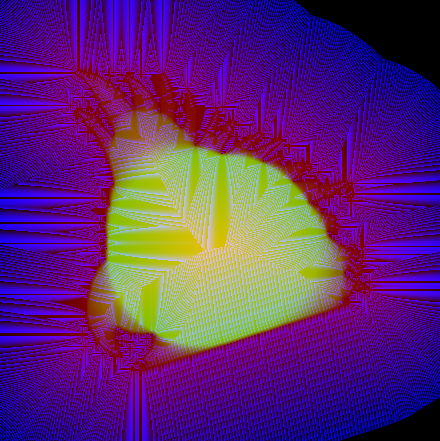
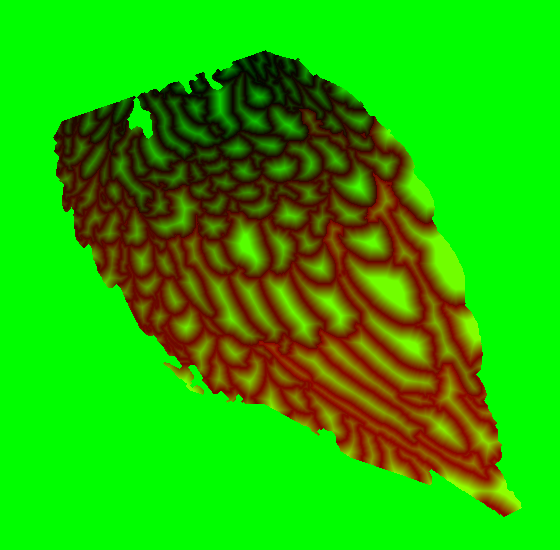
For example, what is this [0] or this [1].
The code is not obfuscated and seems well documented [2]. Maybe, I'll read it later or have an agent explain it to me.
[0] https://alexwang.ai/images/kea/head-fill.webp
cowlevel 1 hour ago | parent
JoshTriplett 2 hours ago | parent
origini 2 hours ago | parent
akavi 4 hours ago | parent
1) Pretraining creates a bias _towards_ "correct answers" with each inference step
2) A longer walk is more likely to land in the correct region, given it's easier to verify you have the correct answer than to create it
3) RL selects the subset of walks that lands in the correct region and tilts the distribution in favor of such walks
4) By 2, that trains towards longer walks
...Is that correct?
EDIT: Wait, but this contradicts the post's claim that "The gains we credit to “thinking longer” come from the search we paid for during training, rather than at inference.". This requires that thinking longer is not at all causal for correct answers, which contradicts 2.
jebarker 4 hours ago | parent
trinari 3 hours ago | parent
jebarker 3 hours ago | parent
HarHarVeryFunny 2 hours ago | parent
There is going to be some minimum length path (assuming the model is generating some semblance of real reasoning), but more long ones given the possibilities for less optimal solves and backtracking after errors, so it stands to reason that if you think longer during training you'll find more paths to success.
At inference time you are hoping to follow one of the reasoning paths discovered during training. You need to generate enough tokens to follow the path (or one of the paths), but continuing to think past this point can only be detrimental - if you are lucky the model will realize the error and circle back, but if you are unlucky it will snatch defeat from the jaws of victory and wander off to who knows where.
There was a story recently linked here about one model "editing the weights" of another and thereby improving it's math performance, which was exactly about this - the need to stop generating at inference time at the right point.
IMO LLM's RL acquired reasoning, even if it gets the job done, sometimes spectacularly (math, coding successes), is really a very dumb cargo-cult process. At inference time the model is just trying to copy what it "saw" at training, without actually understanding it, which may even include duplicating errors and subsequent backtracking that had lead to success during training.
derefr 4 hours ago | parent
Reasoning (i.e. bubbling those remembered words up into your mental context, and then using a special "trigger effectively arbitrary synaptic activations dependent on the content of the attention-masked context and an ongoing state" bridging reflex on them, a.k.a. "system-2 thinking") is how you leverage memories-of-words into useful behavior. Rather than executing native skills embedded into your synaptic weights, you're running a single very fancy native skill that acts as an interpreter for word-memory data, slowly and strenuously turning words you're holding in mind into more words (synthesis), or into associations to other memories (word-memories or otherwise), or into actions/outputs, etc.
(An especially useful "trick" of this system is planning, i.e. chaining the interpreter through "mere words" that conjure more "mere words" to mind until you end up at words that form a declaration of what you're about to do. You can then rely on a special part of the bridging reflex, namely the "instruction-following" reflex, to react in a way where your actions are constrained by the plan you've generated.)
bwestergard 3 hours ago | parent
"RL training directly raises the success probability , by spending a lot of compute on searching for successful paths and then training the model to reproduce them. The gains we credit to “thinking longer” come from the search we paid for during training, rather than at inference."
raincole 3 hours ago | parent
fedpost 3 hours ago | parent
cowlevel 1 hour ago | parent
impossiblefork 1 hour ago | parent
I remember years ago now, trying to feed a text in twice etc., hoping that the representation in the KV cache of the second would end up better. I don't think it worked all that well.
But maybe that is most of the function of restating things babbling. To look at things multiple times.
dist-epoch 2 hours ago | parent
So you use one pass to compute one relevant word, let's say you are working on a sound analysis task, and you output "FFT".
Now in the second pass, FFT is right there at the input, so you can push that idea forward more until you are out of layers again and then you use the output token to prime the next pass.
niemandhier 4 hours ago | parent
I am not sure I support his statement about RL “searching for successful paths and then training the model to reproduce them”.
Don’t we train the model to use a certain method to explore the space in search for an answer?
As soon as you have tool calling and a way to verify your result, such as a theorem prover for example you are essentially running an optimization algorithm.
jebarker 3 hours ago | parent
Not really - you just sample random high-probability completions and then the verifier tells you which ones to nudge the model towards and which to nudge away from. There's lots of clever ways you could improve the search process, but standard practice right now is just random sampling.
piker 3 hours ago | parent
Watching my son work through difficult math problems has forced me into this realization. In my head there is one "correct" path, and I often have to stop myself from interrupting his chain of thought. He often is just getting there a different way.
zmgsabst 3 hours ago | parent
Much of modern foundations is about categorizing reasoning structures by such paths!
0c3ca83 3 hours ago | parent
ryanschaefer 3 hours ago | parent
vatsachak 2 hours ago | parent
htrp 2 hours ago | parent
>I did my PhD in computer science at Stanford, where I designed long-context architectures for sequence modeling and memory. Before that, I studied math & physics at Cornell. Most recently, I was a research scientist at Cartesia, working on in-context tokenization and novel architectures (HNets).
Not the MSL Alex Wang
nycdatasci 2 hours ago | parent
Initially, I typed "intelligence is a path in token space" but then I decided that was too abstract. In case relevant, I was typing on a device with Muse installed.
drfloyd51 1 hour ago | parent
snarkconjecture 1 hour ago | parent
cowlevel 1 hour ago | parent
jibalt 39 minutes ago | parent
That's a remarkable assertion.
usernametaken29 1 hour ago | parent
This is precisely what humans do. We use small world statistics to drastically reduce the search space of problems. Of course there’s the whole issue of contextual search which LLMs address in no way whatsoever, so even improving sampling won’t help much, as inevitably one starts to generate too many hypotheses (reasoning traces) to get a good average.
bugreport671 31 minutes ago | parent