39 points _mpn_ 1 hour ago 42 comments
elevation 1 hour ago | parent
no_carrier 1 hour ago | parent
phyzome 54 minutes ago | parent
topspin 40 minutes ago | parent
That is often exactly what is meant. The problem of running Ethernet through existing structures has spawned a bunch of tools, including glow-in-the-dark "fish tape."
The process is often brutal, and looks like tug-of-war when it takes a couple men to pull the bundle through a couple 90 degree turns. As such, we have "plenum" cable, which is much tougher than typical patch cable, because the latter would just get shredded inside the structure, or snap when pulled with a few hundred lbs of force.
tylergetsay 26 minutes ago | parent
ghostly_s 16 minutes ago | parent
None of these tools are new (well, the glow fish sticks I think are a recent innovation) or unique to ethernet. Electrical wire is installed the same way, eg. in conduit. There's even a special lube for making your wire slide through the conduit easier.
cowlevel 7 minutes ago | parent
esseph 18 minutes ago | parent
bloomingeek 14 minutes ago | parent
mmastrac 58 minutes ago | parent
Recrimping is always the best first step. Sometimes running 2.5gb instead of gigabit will help too.
QuantumNomad_ 17 minutes ago | parent
I ended up buying a small kit containing both crimping tool and a couple of additional tools.
One of the tools included is an Ethernet cable tester. It has two parts; one for each end of the cable. The part on one side is powered by 9V battery (same one used in smoke detectors etc).
You connect the parts to the RJ45 plugs of each side. And it has individual LEDs for each of the eight leads in the cable. They are lit up in sequence. Any that don’t light up means that that pin is not properly connected, or the cable is broken.
And using that tool is how I found out the reason one of the router ports report 100M instead of 1000M connection. Half of the leads on the cable connected to that port are damaged or not properly connected! And the four that are working are the ones needed for 100M.
I remember that when I originally crimped that cable years ago I was struggling for quite a while, getting no connection at first until after a couple of attempts I got it connected. I didn’t notice at the time, nor for a long time after, that it was only a 100M connection. And it took until I had this tool to figure out the why of it being only 100M.
cowlevel 5 minutes ago | parent
_mpn_ 40 minutes ago | parent
fishtoaster 15 minutes ago | parent
piphq70 1 hour ago | parent
jrm4 1 hour ago | parent
dale_glass 1 hour ago | parent
10G is trivially doable on cheap hardware. You can also go 100G, 200G or 400G over the exact same cable, it just costs a lot more on the endpoints.
If you run anything modern you probably can benefit from 10G at least. A NVME does 8 GB/s easily, it's a real pity to limit speeds to 1 gigabit. And Ethernet past 1 Gbps quickly gets pretty terrible to deal with, so might as well go with fiber then.
toast0 40 minutes ago | parent
Obviously, if something is wrong with your existing cabling, 10g-base-t is probably not going to work either. 10G is probably the limit for twisted pair, but I think it'll hold up as a reasonable speed for a long time.
dale_glass 30 minutes ago | parent
IMO, if you want 10G just go with fiber, it's less of a pain and more reliable. With twisted pair you may find out that the module overheats at times and the link drops out.
toast0 11 minutes ago | parent
And the benefit is I didn't have to run new cable. Lots of homes have some twisted pair in the wall, very few have fiber in the wall. Homes from the late 90s on probably have cat5 for phone lines.
cowlevel 3 minutes ago | parent
selectodude 36 minutes ago | parent
Kirby64 40 minutes ago | parent
favorited 1 hour ago | parent
It is genuinely invisible until you get up close. You're far more likely to notice the spots where someone got sloppy with the glue in some corner than the fiber itself. With proper attention to detail during installation (and assuming you have white door jambs and baseboards) it would be basically invisible.
_mpn_ 39 minutes ago | parent
dale_glass 1 hour ago | parent
The biggest part is the LC connector, and you can just take that apart and put it back together -- just remember which was the left and which was the right wire.
That should save the need for special hardware.
readthenotes1 1 hour ago | parent
dale_glass 57 minutes ago | parent
https://momandpop.network/wp-content/uploads/2026/11/PXL_202...
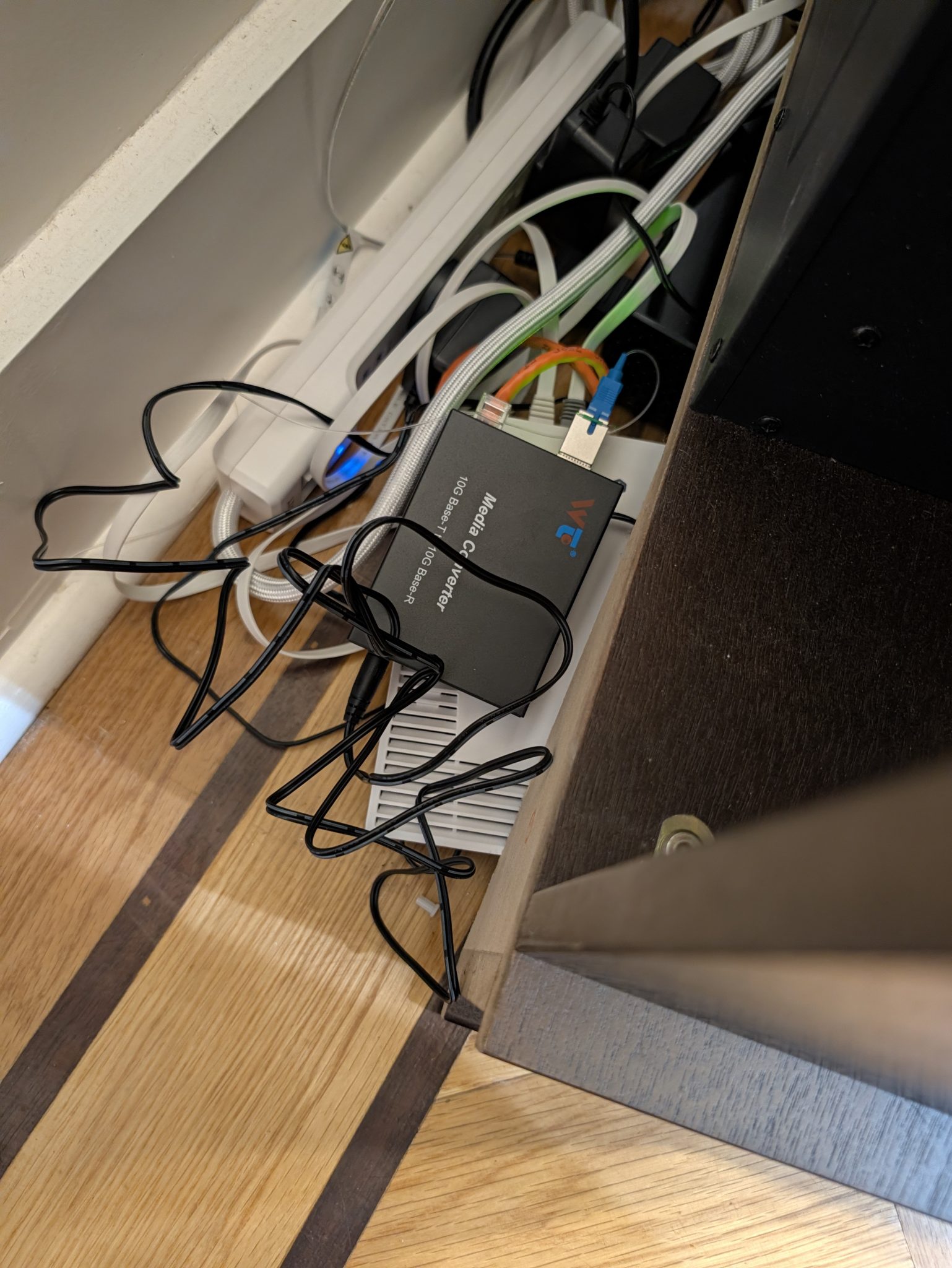
Zoom in on the black box. There's an orange ethernet cable plugged in, and the other plug is the "invisible" fiber.
xbar 44 minutes ago | parent
zamalek 58 minutes ago | parent
_mpn_ 38 minutes ago | parent
But our townhouse was renovated in a post-cable era so Coax was never put in. If it was a 1-2 decades older it would've had coax.
rbanffy 53 minutes ago | parent
bluGill 43 minutes ago | parent
mscdex 37 minutes ago | parent
_mpn_ 26 minutes ago | parent
Quite frankly, people should be doing fiber LANs more, even if the WAN is coax or wireless.
sonicvroooom 30 minutes ago | parent
xur17 4 minutes ago | parent
wyager 26 minutes ago | parent
pak9rabid 26 minutes ago | parent
ghostly_s 12 minutes ago | parent
I’m sure there are some safety issues I’m not considering that make it impractical to pump a high-powered laser into a wall cutout, burn a line-of-sight through all the studs, and install an optical link along the resulting path...
avidiax 11 minutes ago | parent
As to the author's core complaint (CAT5/6 degrading to 100mbps), I've found that the issue is almost always the termination at the jacks. Reseating the wires with a punchdown tool, or failing that, cutting a bit more off the ends and ensuring that the pair twists run all the way to the punchdowns has been enough to restore 1000mbps negotiation the few times I've had this issue.