118 points throwoutway 2 hours ago 104 comments
gnabgib 1 hour ago | parent
brink 1 hour ago | parent
LPisGood 39 minutes ago | parent
brink 20 minutes ago | parent
AI is highly divisive. It's dramatically reduced the value of code, which has derailed a lot of careers who have built their entire adult life around the idea that code would remain valuable, while simultaneously driving others into a psychosis who believe that AI can do anything.
kylehotchkiss 1 hour ago | parent
ares623 1 hour ago | parent
torginus 1 hour ago | parent
ianm218 1 hour ago | parent
I.e. Ramp does a pretty good job of using AI to make expense management easier/ CloudFlare makes it a lot easier to configure stuff properly on CloudFlare but is just like boringly useful.
Jtarii 42 minutes ago | parent
manofmanysmiles 2 minutes ago | parent
IshKebab 1 hour ago | parent
sgarrity 1 hour ago | parent
jdlshore 42 minutes ago | parent
Bleeding obvious in retrospect, controversial at the time.
Jtarii 39 minutes ago | parent
AI will finish what the web and social media started I guess.
VenturingVole 32 minutes ago | parent
matznerd 1 hour ago | parent
Ancalagon 1 hour ago | parent
bartread 1 hour ago | parent
I don’t know about other tasks, but it’s pretty rad for coding, testing, DevOps, and config.
ForHackernews 58 minutes ago | parent
N=1 but I'm not sure it's made my bosses any richer. What we're shipping has better tests and documentation than it ever would have before AI.
0c3ca83 58 minutes ago | parent
I would pay extra for a company that just slowed down and moved deliberately.
kxrm 58 minutes ago | parent
This train isn't stopping.
What trips up a lot of SEs where I work is their techniques. Everyone who follows our process delivers faster and with higher reliability so far.
mguerville 52 minutes ago | parent
moron4hire 38 minutes ago | parent
jeremyjh 25 minutes ago | parent
If you are in software or IT at a non-tech company that is in the fortune 500, the impact of significantly better productivity may not be measurable in aggregate in the company's P&L.
In smaller companies I expect it could be more measurable because some of them really are using AI much more effectively across many functions. But we're finding it very hard to measure meaningful outcomes.
abathologist 9 minutes ago | parent
One plausible explanations that has occurred to me is this: While programmers etc. can produce way more code with LLMs, the declines in quality and coherence of the work, and a widening gap with a coherent strategy and aim for value means the increased activity is mostly not valuable. I suspect this may just be an intensification of https://en.wikipedia.org/wiki/Productivity_paradox#Little_pr...
techpression 20 minutes ago | parent
dboreham 1 hour ago | parent
sublinear 1 hour ago | parent
I'm sure they can just fire half and double up work or outsource. That's the traditional way and it definitely works. The worst that ever happens is a few will reneg on payroll. Everyone who still chooses to work there is happy enough.
The worst that can happen with AI... well...
GolfPopper 1 hour ago | parent
andriy_koval 1 hour ago | parent
ares623 37 minutes ago | parent
simonw 1 hour ago | parent
I don't think that one has held up very well. A cynic might opine that they've realized how easy it is to grab headlines and attention by putting out research that feeds people who are hungry for negative stories about AI.
UPDATE: I'm going to take this one back a a bit: it turns out Apollo publish articles like this on a daily basis, so the occasional headline that appeals to the "hungry for negative stories about AI" crowd is less of a pattern than if they published less frequently than that.
Retric 51 minutes ago | parent
EA-3167 51 minutes ago | parent
jdlshore 50 minutes ago | parent
“The US Census Bureau conducts a biweekly survey of 1.2 million firms, and one question is whether a business has used AI tools such as machine learning, natural language processing, virtual agents or voice recognition to help produce goods or services in the past two weeks. Recent data by firm size shows that AI adoption has been declining among companies with more than 250 employees, see chart below.”
Two questions:
1) What does that chart show today? (Genuine question. I’m curious and don’t know where to find it.)
2) Regardless of what it shows now, why do you think Apollo reporting on it is noteworthy?
simonw 26 minutes ago | parent
I'm writing up a new version of the chart at the moment, but here's a preview: https://static.simonwillison.net/static/2026-11-01/5821A414-...
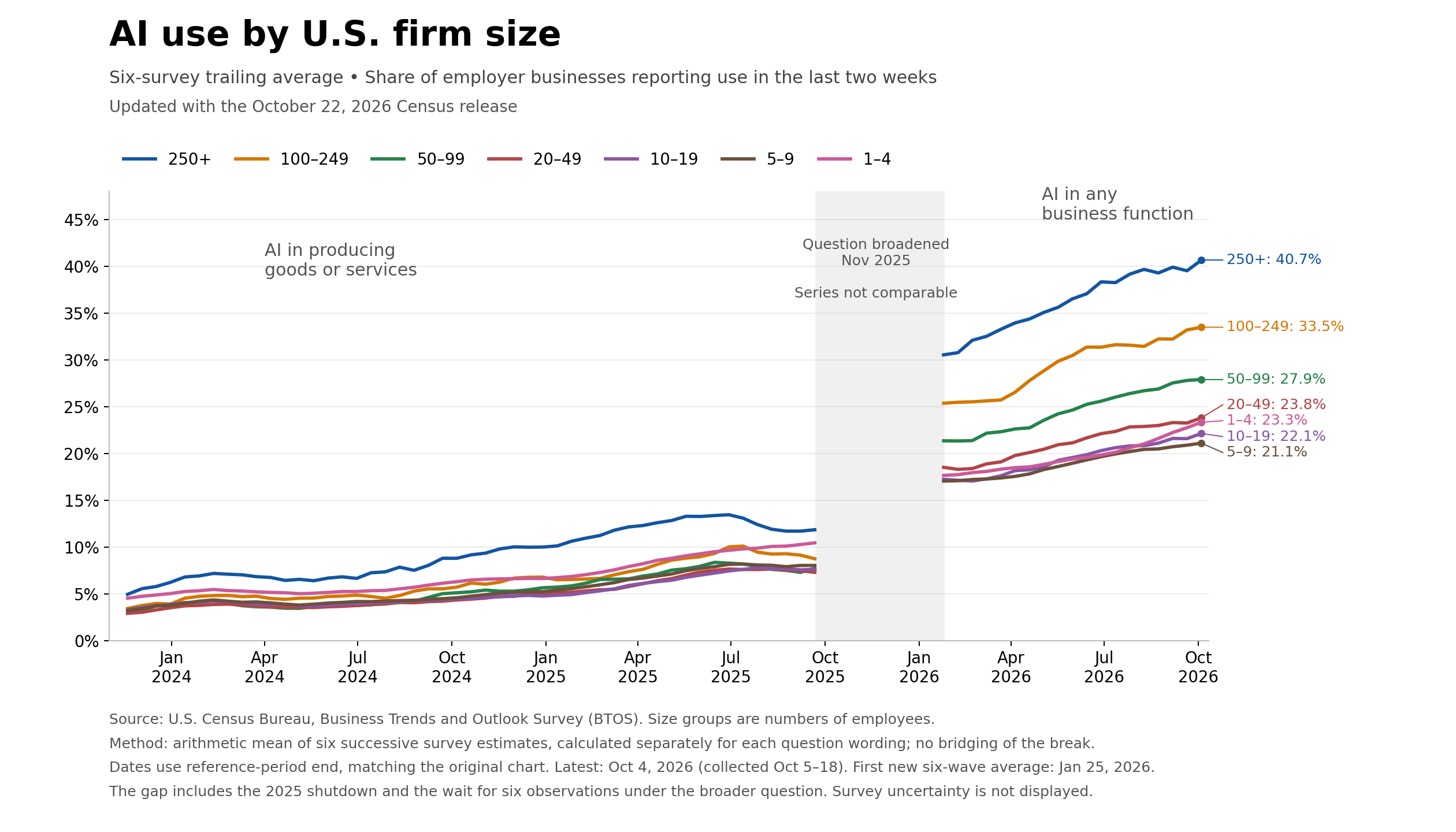
Notes on where to find the data here: https://simonwillison.net/2025/Sep/9/apollo-ai-adoption/
tjwebbnorfolk 1 minute ago | parent
anonymous908213 32 minutes ago | parent
thisismyanon2 14 minutes ago | parent
jesuslop 8 minutes ago | parent
magicalist 2 minutes ago | parent
This is kind of gross. Make the claim or not, don't do this pseudo-sealioning thing. Moreover, engage with the actual content (or you could just not engage at all!), not this shallowest possible dismissal.
ManBeardPc 1 hour ago | parent
smugtrain 1 hour ago | parent
krona 54 minutes ago | parent
claytongulick 33 minutes ago | parent
I think it sums up to something along the lines of "you get what you pay for".
hackernud3s 1 hour ago | parent
jonwinstanley 57 minutes ago | parent
milkshakes 56 minutes ago | parent
speed of iteration is more important than quality of iteration; high iteration speed lowers the cost of failure and compounds improvements
kibwen 27 minutes ago | parent
ManBeardPc 52 minutes ago | parent
hackernud3s 47 minutes ago | parent
ManBeardPc 31 minutes ago | parent
hackernud3s 19 minutes ago | parent
0c3ca83 1 hour ago | parent
At what stage did the engineering fail?
BobbyTables2 53 minutes ago | parent
In a webpage the UI design, authentication, etc. are all “boilerplate” if one just wants to do “X” instead of worry about infrastructure.
slau 41 minutes ago | parent
I see dozens of teams that are doing cloud to the wazoo when really they need to just be told “we’ll load your routes from main.py, build your assets in /static, you need a DB click the button to provision it”.
It boggles the mind that so many teams are reinventing the wheel a million times over to publish their APIs, register AWS accounts, setup CI, decide on ECS vs Lamda, etc.
ManBeardPc 41 minutes ago | parent
0c3ca83 35 minutes ago | parent
macintux 25 minutes ago | parent
ManBeardPc 18 minutes ago | parent
0c3ca83 11 minutes ago | parent
But the problem identified that is talking to people and having them record data.
belorn 21 minutes ago | parent
This area is one which AI has shown to be pretty good (as long as some error rate is acceptable). Character recognition, voice transcribing, converting documents from one standard to an other. I can see an argument that if people spent most time doing those things, AI will speed it up (with a bit of added errors).
I am reminded however that in translations and AI generated subtitles, there is still a lot to be desired compared to the human touch. Handwritten papers in a different language, using local short hand and assumptions, may result in some odd and error prone AI transcription.
grebc 2 minutes ago | parent
blltprfmnk 56 minutes ago | parent
I don’t think anyone is disputing that it makes many kinds of work easier and/or faster, just the degree of those improvements and how much of those improvements actually translate to dollars earned or saved.
Seeing hard data on that would help settle the issue.
whateveracct 49 minutes ago | parent
Nobody even tries to measure this. Their CEOs and board members have AI shares, and potential investors need to see your AI story to justify your valuation. It's a prison of lies.
Esophagus4 46 minutes ago | parent
If developers are shipping more code (and most of the enablement is in software right now) does that show up in top line? Maybe… if sales and marketing are also selling more, and product people are building the right thing, and…
It’s not a straight line from AI -> $$$
claytongulick 37 minutes ago | parent
That seems like it might be a bit of a problem for those frontier model CEOs who have been making exactly the opposite claims.
skydhash 24 minutes ago | parent
s1artibartfast 2 minutes ago | parent
paaloeye 2 minutes ago | parent
With AI, keeping good quality gets even harder because it normally only produces tricky defects.
Veelox 7 minutes ago | parent
Agents accelerated rollout of a data model change by at least 2 months of eng effort.
Those unblocked a $100k/month infra downsizing. That 2 months pays for my team's AI spend for the year.
ares623 40 minutes ago | parent
I understand there's some benefit of this. But is it worth putting the global economy into a death spiral? So ManBeardPc can save 4-9 business days to go and say "yeah, that doesn't work".
proc0 1 hour ago | parent
questionableans 1 hour ago | parent
proc0 39 minutes ago | parent
AI allows you to move faster, but it also demands that you pay more attention in proportion to how fast you want to move. This requires more focus, i.e. more time developing. Effectively the structure at companies should swing back to how it used to be a few decades ago (I think, maybe I'm wrong and it's always been like this), where engineers mostly focused on delivering code. The difference now is that they can be expected to deliver much more code at higher quality.
To summarize, using a little AI doesn't pay off, you need to be doing that all day, and that is not how engineers spend their time in most of the industry anymore.
dboreham 1 hour ago | parent
kylepomykala 59 minutes ago | parent
jeremyjh 21 minutes ago | parent
victor9000 58 minutes ago | parent
temp123477 57 minutes ago | parent
kozikow 46 minutes ago | parent
Your company uses AI and it gets ahead a lot quicker. However, your competition does so as well.
Many areas of economy are zero sum game - so your $ ends up being the same as previously. However, now with a "tax" paid to AI model providers for being able to stay competetive.
jeremyjh 22 minutes ago | parent
TheRoque 16 minutes ago | parent
hyperpape 43 minutes ago | parent
This is a healthy corrective to the most insane AI maximalist takes (mass disemployment in late 2027, 10% GDP growth in a year), but it shows nothing about whether the actual economic impact of AI spending is.
First, to show that, you'd have to justify the counterfactuals (if those companies hadn't spent on AI, would their position be better or worse?)
Second, while AI spending is increasing rapidly, normal companies aren't spending 1% of their revenue on it. So how can you look at a noisy chart of revenue and expect that "oh, it's not up, the AI spending must be useless?" Those companies could be spending < 1% of their revenue on AI, deriving value from it, and it wouldn't be guaranteed to show in a chart like this.
quixoticelixer- 23 minutes ago | parent
mapontosevenths 8 minutes ago | parent
IMO AI contributions to the GDP are only barely offsetting the labor and supply chain disruptions caused by severe mismanagement of the economy. Revenue stays flat despite increasing costs for nearly everything and labor shortages. For that we should perhaps be grateful.
None of these companies can publicly say that out loud though. They would be persecuted and punished by the people responsible for the disruption.
mrdootdoot 43 minutes ago | parent
Anyone agreeing with this headline - I’m sorry in advance for your loss.
Damogran6 42 minutes ago | parent
I'm seeing another behavior in my purely personal research...asking AI 'can I do the thing?' and it comes back with 18 pages of 'yes, and here's how you do it'. Often it's the discovery that produces the endorphin bump. It's cool to know I can jailbreak the Peloton...and now that I know I can...I'm not so motivated to actually do the thing.
arcanemachiner 31 minutes ago | parent
tantalor 42 minutes ago | parent
I'm guessing "most companies" are actually selling something that isn't constrained by the types of things that AI code generators unlock.
jeremyjh 23 minutes ago | parent
jongjong 41 minutes ago | parent
The system itself doesn't reward value creation. I've been saying this for years. I've seen many smart people waste their time on bureaucracy; their intelligence was being wasted; so I'm not surprised at all that now that we have AI, that its intelligence is being wasted as well.
The bottleneck is an allocation issue, not a capability issue.
The current reality is that a lot of very bright people are currently working for big tech in bureaucratic roles and not allowed to focus their attention on 'risky' problems which would deliver real value if resolved.
The current system prioritizes monopolization and is designed to try to ensure that all innovation happens within big tech. It is sacrificing potential innovation which could have occurred much faster outside of big tech in order to ensure that any gains are captured by big tech... But it's sacrificing an enormous about of efficiency.
I hope big AI companies can use their political leverage to try to open up opportunities for people who want to innovate outside of big tech. That's aligned with their long term interests.
I think AI companies are convenient structures which could allow big funds to benefit from decentralized innovation. Could create real win-win scenarios. But those AI companies have to stop pursuing the corporate and government money and prioritize small customers and support small tool makers (or at least lobby the government to stop hindering them with regulations). Also, bootstrapping should be prioritized because VC money mostly creates moats.
charonn0 30 minutes ago | parent
PaulStatezny 6 minutes ago | parent
What a wild scenario to imagine. Anthropic and OAI spending wildly, analysts astonished, thinking we're staring down the barrel of an economic crash. And in the meantime some rogue AI is laughing maniacally and using blackmail to control Altman and Amodei like puppets.
I love it! xD
cl42 27 minutes ago | parent
Apollo's own argument that most AI spend is coming from non-S&P 493 (as per the last two charts) tells me it's hard to make any conclusions based on these charts.
imperio59 14 minutes ago | parent
Much less do they know the thing can build software and maintain it, manage complex tasks daily, automate things, etc.
Then there's a handful that do follow closely AI developments and agents and who have started using them.
A friend of mine this weekend who is an award winning photographer and who has been selling photography courses online forever has told me he's used Muse to: 1) Automate chopping up his long form videos, add captions, and post them as Reels to Instagram. Several of these have gotten over a million views. 2) Automate handling DM reachouts, converting them into sales. He's up to several tens of thousands of dollars in sales from AI direct message conversions that he would otherwise not have been able to convert (too many DMs to handle, he'd have to hire/train sales people to basically just do DMs full time at scale otherwise and it would make no economical sense) 3) Automate all his customer service for handling any issues, refunds, support, etc.
And I personally think he's still just scratching the surface of what he could do.
I feel we are really at the beginning of a new era. When the internet started most people were just using it for e-mail and news, maybe a newsletter chain here and there and some early forums. Social Media didn't appear for well over a decade, popular Web 2.0 apps like Google Maps, GMail, YouTube, Netflix, etc didn't appear for a long time.
Mainstream hasn't even really begun to adopt AI.
gitaarik 9 minutes ago | parent
paaloeye 8 minutes ago | parent
TrainedMonkey 4 minutes ago | parent
1. Execs with no understanding how business operates on the low level are pushing buzzwords.
2. People who want to get promoted deliver on buzzwords and get promoted. Note that the goal is to deliver the buzzword, not use the buzzword to make the business better.
3. Buzzwords do not help vast majority of companies because the incentives and needs are misaligned.
4. Eventually buzzwords settle, some find niches, some die off, and some take over the world.
Last two decades alone - big data, blockchain, crypto, web 3.0, gamification, VR, and now AI. TL:DR - we should expect vast majority of early AI adopters to have net negative to neutral experience. Assuming that AI is like electricity and automobiles more than blockchain we should expect that eventually companies that find a way to apply the tech correctly will eat those who do not.
loeg 4 minutes ago | parent
rossdavidh 1 minute ago | parent