133 points xbmcuser 1 hour ago 56 comments
gustavus 1 hour ago | parent
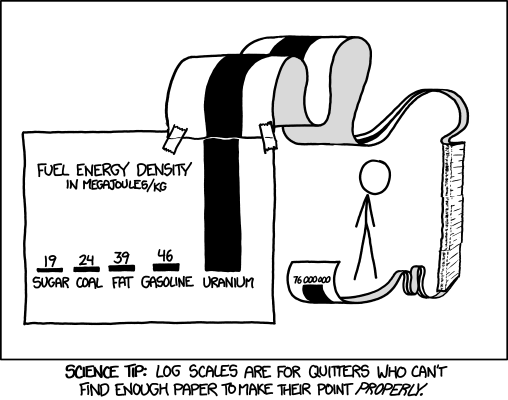
Whenever there is a discussion about nuclear I always remember this XKCD https://imgs.xkcd.com/comics/log_scale.png
tempest_ 1 hour ago | parent
Solar just thrives in places without dependable established grids and has way lower buy in.
Two different tools for different things.
jkahrs595 1 hour ago | parent
Not supported by the stats in TFA:
>According to the report, the gap between renewables and nuclear widened substantially in 2025. Global solar capacity increased by 510 GW to 2,383 GW, up 27% year on year,
Sounds like a quarter of the growth was in the past year.
maxerickson 1 hour ago | parent
https://ourworldindata.org/grapher/installed-solar-pv-capaci...
toomuchtodo 1 hour ago | parent
We solved fusion at a distance with cheap solar and batteries. And not a moment too soon.
ksec 25 minutes ago | parent
They plan to increase 50% for Wind and Solar in 5 years, and possibly double in 10 years. Since 80%+ of all future planned Nuclear reactor are also in China, they would have more than double their renewable energy in 10 years. China is the number one in electricity production and usage, more than twice the size of US and 33%+ of the world. Given the size of China this is both exciting and scary.
toomuchtodo 3 minutes ago | parent
tdb7893 1 hour ago | parent
happytoexplain 1 hour ago | parent
vlovich123 1 hour ago | parent
dgacmu 1 hour ago | parent
trophycase 53 minutes ago | parent
ape4 44 minutes ago | parent
toomuchtodo 40 minutes ago | parent
If you believe solar is ugly and deserts are beautiful, well, “beauty is in the eye of the beholder.” I believe clean, solid state hardware that will reliably produce low carbon energy for decades without causing any harm and potentially contributing positive benefits to its surroundings, with no other inputs required, is incredibly beautiful.
The Great Solar Wall: China doubles down on its ambitious effort to tame deserts - https://www.scmp.com/news/china/science/article/3363108/grea...
Triple win: solar farms in deserts can boost power, incomes and ecosystems - https://www.nature.com/articles/d41586-024-00516-8
Swathes of Earth are turning into desert — but the degradation can be stopped - https://www.nature.com/articles/d41586-023-03621-2
this_user 50 minutes ago | parent
dboreham 39 minutes ago | parent
thisisauserid 1 hour ago | parent
jfengel 1 hour ago | parent
If mainstream news sources do pick up this story, they'll likely cite this article as the source. That's how journalism works. It's not all investigative journalism blowing the lids off of things. They start with knowledge sources. They check the sources against independent ones before publishing, so that they're not just repeating propaganda, but they also tell you where the information came from initially. They may add context from their own knowledge, but the actual news rarely originates with them.
epistasis 1 hour ago | parent
What is your note, precisely?
jfengel 1 hour ago | parent
gryfft 1 hour ago | parent
> Global solar capacity increased by 510 GW to 2,383 GW, up 27% year on year, while wind added a record 159 GW to reach 1,291 GW, an increase of 14%. By comparison, installed nuclear capacity rose by just 1.5 GW to 399.5 GW, while operating nuclear capacity declined by 0.5 GW to 368.6 GW.
> More recent data from IEA PVPS indicate that global PV additions reached around 690 GW in 2025, about 180 GW more than the figure used by WNISR. This suggests the gap between solar and nuclear capacity – and their respective growth rates – was even wider than indicated in the report.
> The report identifies falling battery costs as a potential enabler of continued PV expansion, particularly as grids contend with growing volumes of variable renewable generation and periods of low or negative electricity prices. Grid-scale battery deployment accelerated sharply in 2025, with 104 GW and 257 GWh connected during the year. More than 78% of cumulative battery energy storage system (BESS) capacity was installed between 2023 and 2025.
embedding-shape 26 minutes ago | parent
How much of all of that is China vs the rest of world? They seem to just in the last decade or two absolutely exploded when it comes to solar and other renewable energy sources.
philipkglass 1 hour ago | parent
https://ourworldindata.org/electricity-mix
Even though solar power has been a significant part of the energy conversation for decades, the majority of solar growth is very recent. Nuclear power generated 2762 TWh in 2021, when solar generated 1054 TWh. Solar power generated 2779 TWh in 2025.
dyauspitr 31 minutes ago | parent
silvestrov 26 minutes ago | parent
Denmark had peak coal early (2003) due to early investments in wind power. Coal is now practically gone.
We might see China get the same shift in electricity source as Denmark had over the past 20 years, just much faster.
jakobnissen 17 minutes ago | parent
Put more directly, our numbers look good because Norwegian hydro and Swedish nuclear saves our bacon when our windmills don’t work; China does not have that luxury.
smartmic 1 hour ago | parent
And no, there will be better solutions for base load as well. Battery storage, for example. Sure, it’s a transformation, but those who refuse to think for the future can see the consequences of stubbornness and backward-looking attitudes today.
toomuchtodo 56 minutes ago | parent
Aboutplants 28 minutes ago | parent
k__ 59 minutes ago | parent
What a time to be alive.
mhh__ 56 minutes ago | parent
The one thing I really wish people would take away from thinking about energy / grid composition and so on is that its a portfolio construction problem.
If you ever, ever, see anyone banging on about how expensive or cheap a particularly type of generation is please just write them off as either an idiot or a liar - what matters is the cost of constructing a portfolio of electricity production that meets the requirements of a nation e.g. running an industrial economy solely off solar power is probably impossible but it seems realistic to imagine a "modern" (politics aside) economy that runs off sending emails on a mixture of solar power and storage.
Joel_Mckay 47 minutes ago | parent
However, the upfront cost of Full-sized Fission power facilities are often still around 1/2 to 1/3 the end user $/kWh. The issues arise with the long term waste stewardship costs, and the cognitive disconnect people can engineer their way out of the liabilities.
Now that "AI" data-centers are acting like a public infrastructure equity siphon, in some places private solar can have a payback period measured in under a few years. =3
yxhuvud 23 minutes ago | parent
radu_floricica 50 minutes ago | parent
There is very little actionable information here. Nuclear is still worth building, in countries that don't overregulate it (China is doing it, even while they export the solar panels that everybody is buying). Solar is hitting pretty steep marginal returns on the value of generated watt, because it's all running at the same time and not necessarily when energy is most needed. We still haven't solved cheap battery storage. etc.
phreeza 45 minutes ago | parent
Would be interesting to know how much nuclear vs solar they are building per year domestically.
tonyhart7 41 minutes ago | parent
we literally already have salt battery
tialaramex 49 minutes ago | parent
So e.g. a few months ago in July because it's Summer in the North, solar production peaked significantly higher than the less fluctuating Nuclear but come January it may well produce less globally than Nuclear.
The cited publication is based on Ember's data, which was published in this case a few months ago. It doesn't cite anybody else, so if you're interested in the data and its sources you should look at Ember themselves. This particular publisher (pv magazine) cares about solar specifically, but the nuclear industry publication actually also talks about wind.
Globally wind is much less seasonal (not entirely non-seasonal, but much less so) and it's also generally only sane to build wind farms where there's plenty of wind because they're relatively expensive whereas solar panels are cheap. As a result there's a smaller fluctuation maybe 5:4 between the windy and less windy seasons. However wind power is also growing much more slowly than solar.
You can wake up tomorrow, buy some panels and stick them on a roof, buy an inverter and next week you have solar electricity. Good luck going from "I want a wind turbine" to owning a working wind turbine in anywhere close to that time, even in the unlikely case that you own a hilltop or somewhere to put such a thing.
jl6 48 minutes ago | parent
We need to accelerate clean energy generation even more so we can replace not just dirty electricity sources but dirty energy sources entirely, and produce synthetic petrochemical feedstocks. Modernity runs on hydrocarbons-as-chemicals, not just hydrocarbons-as-fuels, so despite electrolysis and synthesis being hugely energy inefficient, there is literally no alternative. We just have to brute force it at petascale.
luqtas 35 minutes ago | parent
megaman821 28 minutes ago | parent
Aboutplants 25 minutes ago | parent
Not to discount your point of renewables having massive issues, they just simply do not compare to the destruction that is caused by getting fossil fuels out of the ground and the damage it does once we start burning it
plqbfbv 9 minutes ago | parent
We have a giant fusion machine in the sky delivering energy in great excess what we use, and we only capture a tiny fraction of it at the moment. We can make each household practically independent. Fission and (hopefully soon) fusion will be good for meeting grid demand when renewables can't, but a distributed grid is simply more resilient to everything, from local events to country and nation-wide disruption of central generation points.
Kuyawa 30 minutes ago | parent
tcfhgj 25 minutes ago | parent
mallets 14 minutes ago | parent
henry2023 14 minutes ago | parent
jes5199 11 minutes ago | parent
bob1029 10 minutes ago | parent
dv_dt 10 minutes ago | parent
jooops1 4 minutes ago | parent
linsomniac 28 minutes ago | parent
metalman 4 minutes ago | parent
api 4 minutes ago | parent