415 points karakoram 4 days ago 754 comments
wood_spirit 3 days ago | parent
advisedwang 3 days ago | parent
[1] https://www.ons.gov.uk/peoplepopulationandcommunity/housing/...
badatnames 3 days ago | parent
edit: helpful robot boyfriend plotted it https://i.imgur.com/Hp199vV.png

xnorswap 3 days ago | parent
pj_mukh 3 days ago | parent
foldr 3 days ago | parent
dukeyukey 3 days ago | parent
dofm 3 days ago | parent
Grew up in a house built in the 50s, university dorm was built in the late 1800s, student housing was Edwardian at the latest except two houses I lived in as a postgrad, then a place built in 1720 or something, current place is 220 years old on the ground floor plus an Edwardian bit, and I suspect the first and second were first built in the late 1800s; nobody actually knows and it looks like it might have been substantially rebuilt.
The ground floor of this place gets cold; the upper floors have conservation-area sash windows but also ultra-modern insulation under the tiles.
I am trying to avoid listed buildings for the next place, but I would be a bit surprised if I bought anywhere as new as the 1970s! Kind of want an old interwar bungalow next.
rjsw 3 days ago | parent
dofm 3 days ago | parent
(The ground floor of my house, which is, to be fair, quite damp, was built 220 years ago; this is not all that remarkable and my neighbours' houses are fifty years older)
1970s houses are pretty energy-efficient by comparison.
But it's worth noting that a surviving 100 year old house in the UK is likely to be warmer than a surviving 100 year old house in the USA; it is not only brick-built but it is also likely to be in a terrace of several houses, so it has some of the heat retention advantage of an apartment.
The "newer" town in my area is a railway town — it is actually a very old settlement but it became a big important town when the railway arrived in the early 1840s. Much of the housing in that town dates back to the 1860s through to the Edwardian era at the latest and is small houses in brick terraces of ten or fifteen houses in a row (usually in staggered terraces of four or five).
These houses are all supplied with natural gas now, and they have increasingly well-insulated roofs (and loft conversion rooms), double and triple glazing, so they have become warmer and pretty energy efficient.
But in the early 1970s, many of them still would not have been on the town gas supply, they would have been burning a lot more coal, and therefore almost all their supplemental heating (cooking, much of their hot water) would have been electric.
(Edited: 1920 is the median)
mhh__ 3 days ago | parent
esskay 3 days ago | parent
veqq 3 days ago | parent
lenerdenator 3 days ago | parent
esskay 3 days ago | parent
yodelshady 3 days ago | parent
Even parliament acknowledges the effect this has had: https://committees.parliament.uk/writtenevidence/139767/pdf/
That is the most astoundingly smug and tone-deaf question I have ever heard.
esskay 3 days ago | parent
Please debate in good faith.
mhh__ 3 days ago | parent
Energy is what allows modernity to function, we have made it so expensive that no one can make anything in Britain just in time for hard power and manufacturing to be really important again.
Chemicals, metals, pottery, glass,fertiliser etc are all basically impossible to do competitively in Britain.
esskay 3 days ago | parent
Danox 3 days ago | parent
There are many companies that have folded or who are in reduced circumstances in the United States. Many of them were dominant after the war. And they were on top of their game, but despite being on the top, the management team wanted to set themselves up and just wanted to milk the proceeds and primarily stick them into their pockets.
US Steel, Xerox, Kodak, IBM, Intel Microsoft, Motorola Schaumburg, Illinois let’s be honest, most of these companies stagnated at the top, in many areas of modern technology, being on top isn’t the end it’s just the start. of an endless process on a treadmill for as long as you are in existence, as a company. Which is the main reason why Apple had better take the design and engineering of memory in house the treadmill never stops.
pjc50 3 days ago | parent
Hopefully https://en.wikipedia.org/wiki/Eastern_Green_Links will get built and start having an effect before the next election.
praxulus 3 days ago | parent
If people are just going without, then that's generally bad.
esskay 3 days ago | parent
nradov 3 days ago | parent
tom_ 3 days ago | parent
praxulus 3 days ago | parent
Sometimes that's fine if you're just reducing waste. However other times it could mean that you can't keep your house at a reasonable temperature because you can't afford to run your heater/air conditioning enough. That's a form of going without.
NooneAtAll3 3 days ago | parent
I see a lot of comments here see "per capita" and think "residential consumption" - but the decrease is more indicating of general deindustrialization
wood_spirit 3 days ago | parent
barelysapient 3 days ago | parent
amiga386 3 days ago | parent
https://en.wikipedia.org/wiki/Three-Day_Week
> From 1 January 1974, commercial users of electricity were limited to three specified consecutive days' consumption each week and prohibited from working longer hours on those days. Services deemed essential (e.g. hospitals, telephone switchboards, supermarkets and newspaper printing presses) were exempt. Television companies were required to cease broadcasting at 22:30 to conserve electricity [...] The Three-Day Week restrictions were lifted on 7 March 1974.
But nonetheless: https://www.gov.uk/government/statistical-data-sets/historic...
    Year  Avg consumer price in today's money
    1975  13p/kWh
    1985  15p/kWh
    1995  n/a
    2005  11p/kWh
    2015  17p/kWh
    2025  26p/kWh
1) we have to pay off operators for the billions of foreign investment they put into new wind and solar farms and grid storage batteries. If we didn't tempt them with a good RoI, they'd invest elsewhere, and we'd still be burning coal. The cost of this is going down year on year: https://en.wikipedia.org/wiki/Contracts_for_Difference_(UK_e...
2) we're paying for new transmission capacity and replacing worn out transmission route. The fact we don't already have it, which we could've had by charging more for electricity in the 2000s and building it out decades ago, is why today we face enormous curtailment costs today, as we can't get all this wind power from where it's generated to where it's consumed: https://www.telegraph.co.uk/business/2026/10/05/the-bottlene...
3) our market arrangement is based on everyone bidding to supply power, and we pay everyone who generates the same rate as the highest necessary bidder. Thus the moment that there isn't enough wind power, or there is but it can't get to the region it's needed (see point 2), in come the gas turbines and given that Russia's trying to destroy Ukraine, gas is astronomically expensive. The sooner we solve our bottlenecks and decommission all the gas turbines, the better.
excannuk 3 days ago | parent
Are those numbers already corrected for inflation?
graemep 3 days ago | parent
butler14 3 days ago | parent
tweetle_beetle 3 days ago | parent
excannuk 3 days ago | parent
But the raw infrastructure was super reliable in the 70s. If anything we've used digital systems to chip away at the safety margins of the original designs
graemep 3 days ago | parent
On the other hand I have lived in multiple places of varying sorts and regions of England (from London to a village in the North) so I think most places have reliable power, especially towns and cities. Other people's experience is mostly the same.
amiga386 3 days ago | parent
The OP is asking about the 1970s because that's what the headline is comparing to. My point was the 1970s had a lot of problems going on (labour disputes, oil crisis, extreme weather) so it's not an ideal comparison point.
tialaramex 3 days ago | parent
I don't think I can agree with this. CfDs are (typically) a 15 year contract. For each CfD the price actually increases, as a result of inflation adjustment, each year. Dudgeon wind farm got £161.71 per MWh when it began but today gets £220.95 per MWh because of inflation.
Strike prices came down from where they began, but have since bounced around. Hornsea Project 2 is selling today for £80.08 per MWh but CfDs signed this year for similar Wind Farms would be (in today's money) more like £90 per MWh. Much cheaper than Dudgeon, but they are not in fact just steadily reducing in price.
The big boon for CfDs is the certainty for both parties. In 2022 and to a lesser extent again now, fossil fuel prices went crazy and so the less dependent you are on those prices the better for you. If you'd locked in CCGT prices at 2024 levels for 15 years you'd be doing great... except your providers would be bankrupt because methane just isn't available at those prices.
tialaramex 3 days ago | parent
In 2020 22.0 TWh of electricity = £2.3B subsidy so about £104 per MWh
In 2021 21.6 TWh = £1B or about £46 per MWh
In 2022 20.5 TWh = -£235M subsidy - it paid us £17 per MWh
In 2023 20.6 TWh = £1.4B subsidy so about £68 per MWh
In 2024 31.1 TWh = £2.4B equivalent to £76 per MWh
In 2025 35.8 TWh = £2.6B or £74 per MWh
And this year, so far, 26.7 TWh for £1.7B or £62 per MWh
These numbers are pretty big, but even 35.8 TWh is maybe 12% of generation, most of Britain's renewable energy is not subsidised, it just made enough sense in the free market to build, one trick CfDs were used for, which doesn't end up with the government spending any money on a "subsidy" but which does result in more actual generation is that a potential generator would sign the CfD contract and then use a provision intended for practical obstacles - the sand bank you wanted to put turbines on turns out to be unstable for example, to instead sell the power wholesale at prevailing prices and not get a subsidy. That CfD contract made their project easier to finance, but then the market offered more money and they accepted the risk/ reward choice with their finances in place. Banks may or may not be happy they made loans on this basis, we'll find out when these firms go back for another loan and either get a champagne welcome or very different terms.
* All "subsidy" numbers are net additions to the price paid by the "Free market" clearing auction for electricity. Because metric system we can convert the market prices to the kWh units familiar to a household bill payer as "units" of electricity £100 per MWh = 10p per kWh but remember the wholesale electricity is just on some windswept Yorkshire hilltop or something at that price, you need it delivered to your home which costs extra to do.
amiga386 3 days ago | parent
> you need it delivered to your home which costs extra to do
If indeed that can be done at all!
https://ukerc.ac.uk/news/transmission-network-unavailability...
tialaramex 3 days ago | parent
I feel as though there are things in that auction data which are obvious to the generators and maybe the network operator but are utterly opaque to the general public and might help understand why things are as they are or aren't how they might be.
amiga386 3 days ago | parent
amiga386 3 days ago | parent
This is what I was meaning. The fact the contracts are auctioned via competitive bidding (usually) leads to price minimisation. Overall it seems to be a well designed procurement system.
https://www.gov.uk/government/publications/contracts-for-dif...
Anyway, thanks for the additional details, they were very informative.
tialaramex 3 days ago | parent
https://www.lowcarboncontracts.uk/resources/scheme-dashboard...
So that lets me write code for "How much Electricity did we buy this way in year X and how much did we pay for it?" or "If we ignore Drax, can we see what subsidies cost us in each Summer?" and that sort of thing.
You could do much the same in Excel, or indeed if you had your own Power BI - but I can write software, I'm not great at Excel and I refuse to write Power BI reports without being paid for it because it's awful.
Havoc 3 days ago | parent
Currently paying 0.33 usd a unit.
mhh__ 3 days ago | parent
Capacity auctions are iirc pay as clear. Maybe day ahead as well.
One thing to consider as well is that without some external stimulus scheme all of the fossil/nuclear (even ignoring CFD schemes) would immediately go bust IIRC if the market was solely pay-as-bid because wind and solar are cheap but extremely spotty so the price would either be 0 or 1000, probably not the latter long enough to keep the gas plants we currently rely on in business => no more power on cold calm nights.
Havoc 3 days ago | parent
https://www.statista.com/statistics/263492/electricity-price...
[0] https://www.reddit.com/r/technology/comments/1x0tds4/4hour_b...
teamonkey 3 days ago | parent
These things are in progress. A vast amount of generation and storage capacity came online this year and much more still to come. This will gradually take effect, oil conflicts notwithstanding.
jonatron 3 days ago | parent
Someone1234 3 days ago | parent
In fact, if it DID make financial sense, wouldn't companies already be buying up empty/cheap space and then turning a profit after the payback period? Why aren't they?
There are other reasons to do this, but purely on the financial side, I'd want to see the numbers on this one. Again, this isn't about solar, the claim was about battery + inverter + time-of-use paying for itself.
jonatron 3 days ago | parent
nicoburns 3 days ago | parent
Ever? Batteries are 10x cheaper today than they were ~a decade ago. If that trend continues for even a little longer, they'll be absolute no-brainer like solar is today within the next 5 years.
2026 seems to be roughly the break-even point. And whether it's worth it depends on where you live (greatly affects the cost of both installing a system, and buying energy from the grid).
teamonkey 3 days ago | parent
There’s no guarantee things will stay that way though, not least because the more storage added to the grid, the more those arbitrage opportunities get soaked up.
rsynnott 3 days ago | parent
They... are? https://www.energy-storage.news/another-record-breaking-year...
pjc50 3 days ago | parent
londons_explore 3 days ago | parent
jonatron 3 days ago | parent
jl6 3 days ago | parent
Incidentally, the grid only knows about my exports. Self-consumption manifests as demand reduction, so UK solar production and electricity consumption is probably higher than aggregate figures suggest.
mnw21cam 3 days ago | parent
sa46 3 days ago | parent
jonatron 3 days ago | parent
Havoc 3 days ago | parent
RobinL 3 days ago | parent
So for example, for wind power the consumer effectively pays the CfD strike price, largely irrespective of the spot price.
Fwiw, I do agree we have a problem with power being too expensive, but it's more complex than just the consumer pays the most expensive source.
ZeroGravitas 2 days ago | parent
It might get you upvotes on social media but it's 180 degrees wrong.
You've only implied it's unique to the UK but many people will explicitly make that claim to help stoke everyone's anger at the wrong things. Actually it's the standard way to price things in many markets, even outside of electricity and the UK.
advisedwang 3 days ago | parent
Lets say a house typically had 5 60W bulbs on for 8hrs a day, now replaced with an 8W bulb. That would be a 2 kWH reduction, which roughly corresponds to the drop shown in the data.
EDIT: actually now that I think about it, 2kWh per-household is probably less than 1kWh per-capita. It's still a good chunk though!
someperson 3 days ago | parent
Computer fleets across a country do not upgrade immediately so the lag may contribute.
And ACPI was just one energy saving initiative of that era.
PaulKeeble 3 days ago | parent
The UK household has quite significantly cut its power due to all these power saving innovations, far in excess of the actual drop because industry has increased its percentage of the mix over time.
graemep 3 days ago | parent
RubberbandSoul 3 days ago | parent
philipwhiuk 3 days ago | parent
londons_explore 3 days ago | parent
I was surprised how the small amount of infrared from them makes rooms feel more pleasant to be in. It's a warmth on the skin, rather like having a fireplace going.
If I weren't paying the electricity bill, I would totally fit them everywhere.
TheOtherHobbes 3 days ago | parent
It's nothing at all like having a fireplace going - unless they're on fire, in which case both of you have a problem.
londons_explore 3 days ago | parent
OkayPhysicist 3 days ago | parent
bethekidyouwant 3 days ago | parent
triceratops 3 days ago | parent
clort 3 days ago | parent
londons_explore 3 days ago | parent
The main energy saver is simply that the newer LED lights are dimmer!
Grombobulous 3 days ago | parent
OkayPhysicist 3 days ago | parent
linolevan 3 days ago | parent
- reflective housing is super inefficient (~70% losses on the bounced light off typical material, at the top end expensive stuff still ~23%), still better than just losing the light upwards but not as many lumens on the road as a lab test would show
- Today LEDs are more efficient than sodium
Some math: 100W HPS cobra head lamp prdouces 9.5k lumens, including ballast it draws ~133W from the wall. Lab test shows about 70% of the lamp's light leaves the fixture (with the rest being lost in the housing) leading to ~7k lumens exiting. Roughly 53 lm/W.
LED cobra head lamps get like ~125 lm/W on the low end + fade much more slowly than sodium
OkayPhysicist 3 days ago | parent
throwaway198846 3 days ago | parent
jayflux 3 days ago | parent
That said, UK manufacturing decline also correlates with this as that’s very energy intensive. Also don’t rule out fridges, old 90s fridges were very energy intensive compared to today.
> Improved efficiency is also supporting reduced use in the industrial sector – as has a general decline in GB industry and associated intensive electricity use
https://energy.drax.com/intelligence/2024-the-year-electrici...
> This is part of a larger trend. Demand has been falling by 5 TWh per year since 2005. Improving efficiency (lighting, televisions, fridges, etc.), fewer homes using electric heating, and deindustrialisation all play a part
klelatti 3 days ago | parent
noosphr 3 days ago | parent
qlte 3 days ago | parent
noosphr 3 days ago | parent
I hope Europeans remember their colonial history because with how they are managing their economies they are going to have it revisited on them in a generation or two.
jjtwixman 3 days ago | parent
People from the global south like you forget how far north Europe is. Much of Europe never needed it. Now maybe it does for a week or two per year. Things will change.
noosphr 3 days ago | parent
amiga386 3 days ago | parent
Northern Europe's main problem, every year, is keeping people warm in the winter. Heat death in the summer is a novelty. Global warming will actually reduce excess mortality in Europe, because warming winters will save more people than hot summers kill.
On the other hand, people on the equator are FUCKED: https://ourworldindata.org/grapher/change-heat-death-rate?ta...
Timon3 3 days ago | parent
Is this informed by studies, or are you just assuming "global warming = higher average temperature = less cold"? Because that's not how the climate works. It's very well possible that global warming increases the number of cold-related deaths in Europe.
amiga386 3 days ago | parent
Timon3 3 days ago | parent
ChrisRR 3 days ago | parent
hgomersall 3 days ago | parent
mhh__ 3 days ago | parent
saberience 3 days ago | parent
advisedwang 3 days ago | parent
a_paddy 3 days ago | parent
cm2187 3 days ago | parent
But their great idea to deal with the shortage is intermittent availability of power. You won't be able to wash your clothes when you feel like, you will have to adapt to when there is spare power, like in developing countries. This is just a regression in technological progress.
I saw the same messaging in France where the current president started his mandate with a grand programme to switch off a third of nuclear power plants.
If anyone thinks adults are in charge, let alone engineers, you are greatly mistaken.
nradov 3 days ago | parent
verisimi 3 days ago | parent
snapplebobapple 3 days ago | parent
secretsatan 3 days ago | parent
233mhz 3 days ago | parent
snapplebobapple 3 days ago | parent
epistasis 3 days ago | parent
People working on the grid and in utilities are coming at this from a completely different perspective than degrowthers, in my experience. Grid ops are extremely conservative, and utilities have not adopted new tech in decades if ever, so they look at the trend of the past decades and think "the future is going to be exactly the same." They are not thinking of the grid change we need to deal with climate change, at least in the US.
I only have deep understanding here in the US, but the "degrowth" subfaction of progressives are completely ineffectual, despite being very loud. They have zero influence, zero ability to organize into any sort of group with influence, and little desire to do anything except critique others. They can be safely ignored, because even their critiques are based on either very fundamental misunderstandings of the world, and they can only infect a very tiny subset of the population with their mind virus of ignorance.
Perhaps other places, like the UK, has a more politically effective group of degrowthers. But in order to even believe the things they believe they have to dumb themselves down quite a bit so if there are politically effective degrowth movements it may be time for me to reevaluate my position. Anti-vaxxers are far more effective politically, despite having just as poor critical thinking skills, but with the anti-vax movement individual action has big impacts, unlike with grid decisions.
TheOtherHobbes 3 days ago | parent
Degrowthers, who have had some reasonable successes like the Passivhaus movement, are opposed by those same bot farms.
tenacious_tuna 3 days ago | parent
Matching demand to production where possible strikes me as a sane approach. Western nations have become very used to an incredibly high standard of living largely powered by disproportionately massive energy consumption per person. If it uses power more efficiently to dry one's clothes at night or run the dishwasher overnight, rather than during the day alongside AC and computers and whatnot, that seems eminently reasonable to do.
This sharp resistance to minor personal inconvenience is bananas to me. If the alternative is to bring massive battery storage or nuclear plants online, vs "hey, maybe charge your car overnight" or "hey, timeshift your AC use and add some insulation to your house," why wouldn't we do that?
tancop 3 days ago | parent
Making peoples lives worse to save money is a capitalist mindset and I don't understand why so many left wing people believe in it. The promise of socialism was always higher living standards for the working class (99 percent) at the expense of millionaires.
yostrovs 3 days ago | parent
wahern 3 days ago | parent
The misanthropy is infused in popular culture, and specifically in the way ecological sciences and history (for additional reasons) is taught in schools. I not infrequently have to discuss this with my kids when they recite something they've learned in school and I can hear the misanthropic cynicism in the framing and intonation.
TheOtherHobbes 3 days ago | parent
Making your own planet less ecologically stable is certainly an interesting choice, but probably not the best long-term bet for anyone's kids.
Shog9 3 days ago | parent
Be wary of anyone who argues the poor should go without food or protection from the elements, regardless of what flimsy justification they give for their cruelty; the most dangerous to each of us are those who appeal to our own beliefs.
Dylan16807 3 days ago | parent
themanualstates 2 days ago | parent
Especially when you’re maddened about incoherencies that are merely the manifestation of the inherent entropy of our world!
ballmerpoint 3 days ago | parent
jfengel 3 days ago | parent
If one consumed nonfiction media one might get a different impression.
timmmmmmay 3 days ago | parent
tenacious_tuna 3 days ago | parent
I'd argue there's more ecologically sound ways to supply the desired energy demand in combination with shifting some of the load away from peak times. I don't think that strictly correlates to "a lower standard of living" so much as "there's minor behavioral changes that would more efficiently use existing resources."
> Making peoples lives worse to save money
This is exactly the mentality that I'm surprised by: I suggest shifting high energy use slightly and your reaction is "that will make my life worse." Would it really have a strong negative impact on your life to run your dryer overnight for your towels/sheets/whatever if it meant 50% cheaper power?
boredhedgehog 3 days ago | parent
Absolutely. That thing is loud.
tenacious_tuna 3 days ago | parent
triceratops 3 days ago | parent
What if manufacturers developed quieter dryers?
pigpop 3 days ago | parent
ButlerianJihad 3 days ago | parent
The last time I had in-unit W/D, it was right outside my bedroom. Never bothered me in the least. Certainly not compared to the neighbors' dogs, pot-smoking, screaming arguments, etc.
triceratops 3 days ago | parent
According to https://www.energysage.com/electricity/whats-the-cheapest-ti... 9pm - 6am is common in the US. Hardly anyone is in bed by 9pm.
In the UK it's 10pm - 5am or midnight-7am, depending on your plan. https://uk.jackery.com/blogs/knowledge/when-is-off-peak-elec.... But there's also a mid-day slot 1pm-3pm which can work if your dryer can be timed.
You can also dry heavy items on a folding rack so the dryer doesn't run as long.
lazyasciiart 3 days ago | parent
lowbloodsugar 3 days ago | parent
In a london flat we rented, the washer-dryer was in a cupboard in the bedroom. So yes. At least it had one.
secretsatan 3 days ago | parent
dalyons 3 days ago | parent
yostrovs 3 days ago | parent
tenacious_tuna 3 days ago | parent
I'm not saying human convenience should entirely take a backseat to machine efficiency; to your point, the very existence of these things is to make human life easier. My frustration is that Western approaches to these problems seem uniquely resistant to ever altering behavior for the sake of reducing ecological impact.
(Dishwashers were a poor example for me to use anyway, they're remarkably efficient; a better one might be water usage: it's best to water plants in either the early morning or late evening, so the water doesn't evaporate as much, but people often prefer to do so during the day, which coincides with high household water usage for showers/laundry/whatever. though, I routinely run my dishwasher overnight and have never had issues with grime, so long as I prime the hot water feed.)
James_K 3 days ago | parent
Sharlin 3 days ago | parent
jawiggins 3 days ago | parent
TheOtherHobbes 3 days ago | parent
jawiggins 3 days ago | parent
Marha01 3 days ago | parent
Those minor conveniences are a drop in the bucket when it comes to total CO2 output.
Tade0 3 days ago | parent
That's a uniquely American perspective.
Japanese homes often don't have space heating. The Swiss often keep their homes at 20°C in the winter.
Most of the globe doesn't travel everywhere by car. Arguably it's the intention to remove pain as much as possible which resulted in the opioid epidemic.
There's a point at which trying to get rid of inconveniences becomes harmful.
ndriscoll 3 days ago | parent
tenacious_tuna 3 days ago | parent
Chicago building codes require 68F as a minimum for residential in winter conditions, so I think that's reasonable as a "habitable minimum yet not necessarily ideal" benchmark: https://www.chicago.gov/city/en/depts/bldgs/supp_info/chicag...
ndriscoll 3 days ago | parent
Tade0 3 days ago | parent
ndriscoll 3 days ago | parent
Tade0 3 days ago | parent
The thing about the nations I mentioned is that they either barely use any AC, like Switzerland, or set it to 25°C or more, like Japan.
They embrace discomfort - most of the world does.
SoftTalker 3 days ago | parent
If it's in the 80s outside, I'll probably drop the inside temp to 76, again to keep humidity down. I rarely set it below that. 74 feels cold in my normal summer attire of shorts and a tee shirt. If we have an 80 degree day with low humidity, I'll open the windows.
lazyasciiart 3 days ago | parent
eddythompson80 3 days ago | parent
Tade0 3 days ago | parent
The rest of the world also has these things, just doesn't use them nearly as much.
eddythompson80 3 days ago | parent
50 years ago hot middle eastern countries had no AC. Not because they had some sort of symbiosis with nature and the summer heat. It was because the average AC costed the sum of 8-month of average income. As AC prices dropped, and the average income increased, having an AC became the norm.
Of course the richest people, richest economies get their first and to a non inquisitive or surface only thinking, it’s some how a unique was on discomfort or lust for luxury, when it’s just simple economics. You can see rich Asian countries and cities leading the “War on discomfort” now a days as their economies have developed and stabilized, but they face unique discomforts that previous rich nations didn’t.
Tade0 3 days ago | parent
In absolute terms, yes. But per capita there are quite a few richer countries, like Switzerland, where people genuinely seem to brave the elements as part of their culture.
Sure, everyone adopts conveniences, but I've never seen anyone do it to the extent Americans do.
eddythompson80 2 days ago | parent
> I've never seen anyone do it to the extent Americans do.
Sounds more like observational or cognitive bias tbh. For example, the Japanese market is notorious for building gizmos and machines for far less grand inconveniences that the weather or long-distance travel. They eat a lot of rice in Japan, so it makes sense they invented the rice cooker. To many Americans (today) who don't eat a lot of rice having an entire appliance for just cooking rice might seem like a crazy war on discomfort and too much of adopting convivences. What's next? a machine just for Turkish coffee?
hobo123 3 days ago | parent
Whenever I go shopping, it's insane how much they heat most places, while people are wearing heavy winter jackets.
krona 3 days ago | parent
The UK has the oldest housing stock in Europe, and most likely in the world. [0]
Roughly 30% of the stock is single-skin, without a cavity. While it's not impossible to insulate such walls, it's generally inadvisable for many reasons. The same goes for the roofs of these houses; although you will find many companies willing to spray your roof with foam or other forms of thermal sealing, those roofs were never designed to be insulated, causing other potentially catastrophic problems once it's been done.
Generally, the poorest and oldest people in society occupy these houses, but no matter; the government will ban the sale of gas boilers to coerce them in to installing heat pumps, despite them being incompatible with the existing pipework and radiators.
0: https://files.bregroup.com/bretrust/The-Housing-Stock-of-the...
sdsdssweew213 3 days ago | parent
maccard 3 days ago | parent
That said, most properties in the UK don't have this problem. They _do_ likely need bigger radiators which comes with a cost, but a lot of these houses would benefit from just upgrading from their single panel rad with no fins.
hobo123 3 days ago | parent
wongarsu 3 days ago | parent
I'm not sure any of that makes heatpumps technically impossible, but it makes them more expensive and less efficient
mindslight 3 days ago | parent
Meanwhile the efficiency (COP) of a heat pump drops the higher its temperature differential is. So trying to keep the water loop temperature the same is a non-starter. (The same problem can happen with high efficiency condensing natural gas boilers which have much lower flue temperatures)
(From an American perspective although I'll convert the units) - older radiator systems were designed for water temps of around 80C, room temp around 20C, so that is 60C (60 K/Kelvin, really) delta-T. Whereas if a heat pump wants to put out 50C water for half the delta-T (30K), you then need twice the amount of radiator surface area to transfer the same amount of heat. The system will work fine in the shoulder seasons when not much heat is required, but at the coldest nights design temperature it will not be able to keep up and your indoor air temperature will then drop despite the heat being on.
(Pipe sizing enters into it as well but isn't as straightforward to explain)
Scoundreller 3 days ago | parent
(And re-arranged the furniture a bit + stopped using the radiator as storage...)
jvvw 3 days ago | parent
Reason077 3 days ago | parent
I guess it's cheaper to not have to install air ducting or indoor units if you can reuse existing pipes & radiators. But if you need to replace the radiators anyway, the cost might not be that much different? You'd get more precise temperature control, and cooling in the summer.
Macha 3 days ago | parent
whatevaa 3 days ago | parent
Mini-splits are noisy and have major problems getting heat distributed over a whole house.
tenacious_tuna 3 days ago | parent
Reasonable point, but I feel my case still stands: the population able to make these changes could do so, enabling existing infra (and housing stock) to "go further" before requiring expensive and disruptive overhaul.
> the government will ban the sale of gas boilers to coerce them in to installing heat pumps
I agree this is shortsighted, and it's better to incentivize more efficient systems rather than applying punitive strategies to less efficient ones.
Fabricio20 3 days ago | parent
I'm sorry but as an outsider to me this straight up just sounds like kicking the can down the road! Let's get it fixed, build more solar, get more power in the grid, deregulate personal solar so its an attractive incentive to get more people generating power, etc.. Rather than "you need to use less" mentality, especially while people literally die to the heatwaves the UK has been getting recently..
It's been pretty clear that globally the grid operators are all very much lazy and would rather increase prices and reap benefits short term than adding more capacity to the grid, even where i live (in Brazil) its very much clear that grid operators too would rather raise your bill and collude to add more taxes if you want to generate your own solar than to get more supply in the grid and make the bills cheaper (we have a minimum bill you have to pay even if you have full self-generated solar AND a thing called a "solar tax" because of course, the sun is the govt's property, gotta pay a tax for using it..).
tenacious_tuna 3 days ago | parent
> Rather than "you need to use less" mentality, especially while people literally die to the heatwaves the UK has been getting recently..
I'm not saying _everybody_ must use less AC/clothes dryer/whatever. Grids are remarkably complex machines and are incredibly expensive to upgrade--which we should do! We should have done that ages ago, but the second best time to plant a tree is now. However, that's not an instantaneous process and requires quite a lot of political willpower to achieve, let alone the capex to bring new generation plants online.
In the meantime, as you've noted, people die without access to critical infra, i.e. AC in heatwaves. If the options facing grid operators are "rolling brownouts to keep from blowing up a transformer" or "educate people on time-of-day use re: peak load to reduce grid strain," the latter is often dismissed out of hand when it seems a perfectly sane approach to maximizing the utility of existing systems.
> deregulate personal solar so its an attractive incentive to get more people generating power, etc
Solar has a tremendous to "democratize" access to resources [0], we should absolutely incentivize its adoption as much as possible... but changing regulatory or tax environments is difficult. *We should still do that,* but altering behavior is (comparatively) free, so long as you can get past people being personally offended for being asked to not water their lawn every day in July.
hkt 3 days ago | parent
Further, it is possible to run a heat pump at high temperatures: some use refrigerants specifically designed to do this relatively efficiently.
krona 3 days ago | parent
Several energy suppliers websites have pages dedicated to this very topic.
The current 2035 target originates in the ministerial Heat and building strategy policy paper (2020):
"Our ambition is to phase out the installation of natural gas boilers beyond 2035."
In the Annex:
Aiming to phase out the installation of new and replacement natural gas boilers from 2035, once costs of low-carbon alternatives have fallen, in line with the natural replacement cycle, including any hydrogen-ready boilers in areas not converting to hydrogen, to ensure that all heating systems used in 2050 are compatible with Net Zero.
Given the energy policy of the UK, which to many engineers makes absolutely no sense at all, it's impossible to predict what will actually come out of the policy sausage factory next.
youngtaff 3 days ago | parent
Eventually everyone will need to switch from gas because as the number of heat pumps rise then number of gas consumers fall and the infrastructure costs for them will become uneconomic
amiga386 3 days ago | parent
England: from 24 March 2027
Scotland: since 1 April 2024.
The legislation doesn't mandate heat pumps specifically, it mandates >=75% lower carbon emissions than homes built to the 2013 standards, which effectively requires heat pumps, solar panels, and significantly improved insulation. Build and running costs aren't measured, it's quite possible new homes will cost more to buy and run, and could be smaller to compensate.
You remember "2035" because in 2021 the government announced it "wanted" to ban gas boilers entirety by that date: https://www.bbc.co.uk/news/business-58959045
... but as far as I know, never enacted legislation to ban their sale or fitting in existing houses. And that aspirational policy has been announced as dropped multiple times, at least since last July, most recently today
toyg 3 days ago | parent
New builds are already much smaller than previous generations' housing, to increase margins for developers. Smaller than that, we'll basically be like rats.
adrianN 3 days ago | parent
whatevaa 3 days ago | parent
youngtaff 3 days ago | parent
Lime plaster with cork in it is fine way to insulate these buildings.
It won't be as good as modern materials but is an improvement and is breathable
> Generally, the poorest and oldest people in society occupy these houses,
I own one of these houses – single skin, 200yr old farm workers cottage – I'm neither poor or that old
Much of the expensive old housing in London, Bath etc is single skin too
stuaxo 3 days ago | parent
coryrc 3 days ago | parent
mrob 3 days ago | parent
I assume you're in good health, not poor, in a stable living arrangement, etc. The burden of "minor personal inconveniences" depends greatly on how many inconveniences you already suffer. Somebody working two jobs doesn't have much spare energy for optimizing utility use.
maccard 3 days ago | parent
Most of us don't. But smart meters are free in the UK, and if there was a way for my washing machine to have a 3h window overnight to run in to be done for 7:30 I'd do it in a heartbeat. Same for my dishwasher. Heating is a bigger issue.
dmurray 3 days ago | parent
There should be plenty of opportunity to load shift with other things though, a dishwasher as you mentioned, or a fridge or a storage heater or a charger for your electric car. All can be done with minimal inconvenience to the user.
leni536 3 days ago | parent
I think most of these appliances sold today have at least some sort of "delay start" function. We use that to do exactly what you describe. Not even for nght tariff, it's just convenient to time it like that.
Jtsummers 3 days ago | parent
leni536 3 days ago | parent
maccard 3 days ago | parent
tenacious_tuna 3 days ago | parent
Excellent point, and I agree, though the vast, vast majority of the pushback I feel I get when advocating for these kinds of shifts are from wealthy/healthy individuals.
It's a classic tragedy of the commons scenario: existing resources should be able to support our current level of creature comforts with minor conservation, even if a segment of the population is less able to support the conservation efforts, but the extremes people demand in turn place extreme load on our infrastructure.
barrkel 3 days ago | parent
williamdclt 3 days ago | parent
Frieren 3 days ago | parent
That is exactly the people reducing expenses even when they know that will be extremely painful. That is why the poor are poor, because they cannot afford that kind basic expense. They need to choose between heating and food.
"Let's consume more" for the poor. It is a grotesque argument.
tenacious_tuna 3 days ago | parent
OP was making a fair point that not everybody has the same amount of time and energy (or money) to tolerate shifts in their routine, which in the context of a "personal vs collective responsibility" style argument is entirely reasonable.
By the same token, if only the _rich_ have the freedom to make such behavior changes for the sake of conservation it will only ever have a token impact, and in many cases the "correct" level to make an efficiency pitch at is the community: a decent light rail system will always outperform everyone driving their own vehicle to work/the store/downtown in terms of space and energy efficiency.
...but, to get people to buy into such "collectivist" systems, you often have to get them to contend with some perceived reduction in personal convenience: yes, a train doesn't need a parking lot and uses less gas per passenger-mile, but then you're beholden to the train schedule. It's exactly _that_ sentiment that I find frustrating in advocating for sustainable civic design.
To OP's point: whatever that "collectivist" option is necessarily has to contend that standards of accessibility and convenience are not constant across the population. That doesn't inherently mean "the poor should consume more," but that "hang dry your laundry" isn't an option for everyone in the current dominant socioeconomic structure.
sdsdssweew213 3 days ago | parent
tenacious_tuna 3 days ago | parent
maccard 3 days ago | parent
Adding insulation is expensive, and awkward. If you have cavity walls that are uninsulated, it needs to be done right. If you have single skim walls you either do external cladding (and change the outside of your building), or build an internal stud wall and insulate that, which is very effective but costs a decent amount, reduces internal floor space, and requires a full redecoration after.
Frieren 3 days ago | parent
Expensive short term, life saving long term.
> requires a full redecoration after
Tell me that you are rich without telling me that you are.
youngtaff 3 days ago | parent
Lime render with cork is the outside version
fourseventy 3 days ago | parent
eli_gottlieb 3 days ago | parent
No, you're supposed to do the other way around.
cameldrv 3 days ago | parent
If we're going to electrify everything, we need a clean, plentiful, reliable electrical supply. There is no technical obstacle to having this.
Saying "we can save $1000 per person in capital costs, they just need to deal with 5 extra minor inconveniences per day" is not how you run a developed country.
coryrc 3 days ago | parent
ilikerashers 3 days ago | parent
Having to install battery capacity in your own house is a step backwards.
If water was unavailable for 4 hours a day, you would suggest putting in your own rainwater filtration system.
coryrc 2 days ago | parent
leonidasrup 3 days ago | parent
But for example, cement production can be turned on and off quite easily, and is turned on and off on demand by the grid electric operators to help with grid stabilization (cement producers are paid for this grid stabilization service).
anax32 3 days ago | parent
That's the way our system has developed for millennia.
anthonypasq 2 days ago | parent
tenacious_tuna 2 days ago | parent
It's not a "preferable" strategy, it's one that can (and should) be deployed in tandem with expanding our renewable generation and doing more "at scale" conservation of commercial resource use.
We're already building wind and solar at bananas rates [0], _and yet_ we're not even capitalizing on that gain as much as we could because people don't want to tolerate the behavior changes necessary to do so.
My beef isn't with expanding capacity, it's with that being the _only_ solution that's considered to match supply to demand instead of doing anything to manage demand.
anthonypasq 2 days ago | parent
no we arent. China added the entire capacity of the US grid in solar in the last 4 years and they are accelerating. That is bananas. We've barely increased total grid capacity in the last 20 years. It should be a national embarrassment. Energy abundance is possible, and one of the greatest ways to improve peoples lives. There are no energy poor countries that are rich.
Half the state of Nevada should be a solar farm at this point if anyone actually cared about climate change, and that would do 10x to imrpve peoples lives than telling them not to use the dryer.
again, the degrowth mindset relies on a fundamental paucity of imagination and will to actually solve the problem.
ballmerpoint 3 days ago | parent
That few in government are readying for that and are rearranging deck chairs instead is not particularly reassuring.
antisthenes 3 days ago | parent
Now I'm not saying we should generate as much as humanly possible, because even with renewables that has a cost.
And some things have gotten genuinely more efficient (compare modern heat pumps to heating available in 1968).
But why shouldn't we maintain the levels our parents enjoyed? And use the extra capacity if anything for EVs, grid stabilization, medical research, etc.
So population degrowth is a pretty separate issue.
expedition32 3 days ago | parent
That is the power of modern construction techniques.
Unfortunately this is out of reach of poorer people and it would takes a hundred years before all the old housing stock is replaced. But it's nice progress for the happy few.
pigpop 3 days ago | parent
lukeify 3 days ago | parent
AnimalMuppet 3 days ago | parent
lukeify 3 days ago | parent
pigpop 1 day ago | parent
vkou 3 days ago | parent
I'm going to go with the degrowth, or the steady-state economics guys, they are more likely to be closer to the mark of what is actually achievable in the real world.
kypro 3 days ago | parent
It's not just degrowth mindset, but the dogmatic refusal to be pragmatic on energy. Given most UK homes are heated by gas and we have a lot of gas-powered power plants, it makes no sense for us to import natural gas where we can avoid it (especially LNG) as it's more costly and less green than domestic production.
Plus, domestic production means more domestic jobs and additional tax revenues.
It seems to me there's basically no upside of us refusing to exploit what we can of the North Sea. It's just people taking an ideological dislike to us doing it domestically because "fossil fuels = bad".
Some people also just seem wildly misinformed. For example, our media seems to think 50% of our energy problems stem from it being priced wrong. I guess we have the same problem with housing – maybe everyone could have a home if we just sold them for less. It's really very stupid.
youngtaff 3 days ago | parent
throwaway473825 3 days ago | parent
teamonkey 3 days ago | parent
Well, fracking kind of is, we stopped after we tried it and it caused ground tremors.
youngtaff 3 days ago | parent
Part of the problem with fracking on mainland UK is not just the tremors but that there’s also not much proven gas either
panick21_ 3 days ago | parent
And its in no way going to solve any of the actual long term energy issues in the UK.
For example, if you assume limited government resources, massive investment in North Sea fossil is just inherently stupid.
Allowing some private exploration and production would be tiny and barley relevant to solve any problem. The right wing people who advocate this as some kind of 'solution' are more delusional then any 'leftist'.
jhoechtl 3 days ago | parent
Take the idea of not being able to wash your cloths when you want. What a step back! But instead get rid of your heated pool or turn down heating by two degrees.
apercu 3 days ago | parent
streetfighter64 3 days ago | parent
233mhz 3 days ago | parent
- climate change is having real measurable negative impacts already
- 90% of the shit we create is useless low quality junk and e-waste with a two years life expectancy
- green washing doesn't change the fact that the vast majority of industries are not compatible with long term sustainability
What are your argument for infinite growth at all cost?
cyberax 3 days ago | parent
Here's an example of how to bullshit. The original report is here: https://www.worldwildlife.org/news/press-releases/catastroph...
And it's missing the word "monitored". And then you read the methodology:
> The LPI measures changes in the sizes of 35,803 populations of 5,790 vertebrate species (amphibians, birds, fishes, mammals and reptiles) that have been monitored over time. The latest LPI shows a decline of 73% (73.2%). This means that the size of these populations fell by, on average, 73% between 1970 and 2022.
> This doesn’t mean that there are 73% fewer wild animals in total today than in 1970. The LPI measures changes in relative abundance, not the total number of animals. Changes in small populations with few individuals are averaged with changes in large populations of thousands of animals. Nor does it mean that 73% of species or populations are declining. In fact, around half of the studied populations are stable or increasing – but these gains are outweighed by the greater magnitude of losses elsewhere when calculating a global average.
So basically, it's a made-up number.
233mhz 3 days ago | parent
cyberax 3 days ago | parent
Mammoths disappeared without human intervention, for example.
233mhz 3 days ago | parent
cyberax 2 days ago | parent
I just don't think that the only natural state for the Earth is change. And human-caused changes are neither bad nor good from that standpoint.
testing22321 3 days ago | parent
anthonypasq 2 days ago | parent
mindslight 3 days ago | parent
But yes I do agree about the impossibility of communication.
Barrin92 3 days ago | parent
the logical terminus of the growth fanatics is to literally want to leave the planet so I think we ought to reserve the label 'alien' for them
yyyk 3 days ago | parent
Lammy 3 days ago | parent
carlosjobim 3 days ago | parent
adventured 3 days ago | parent
For some on the left, they view humans as parasites. It starts as self-hate internally and expands outwards to encompass humanity more generally ('I love animals, I hate people'). Humans have to modify their environment to exist (shelter, farming, hunting, et al.), so the people that hold that ideology, you will find, they comprehensively hate any modification of the environment by humans, ie they want humans to cease to exist, rooted first in their own desire to not exist (they hate their own existence first and foremost).
The world is at all times overflowing with people that hate existing. They're miserable sad sacks and they desperately want everyone to drown in it with them. Sometimes that gets formalized into projected ideology used as a weapon against the rest of humanity.
preisschild 3 days ago | parent
otikik 3 days ago | parent
Everything must grow all the time because all we care about is compounding interest, and that can only exist with continuous growth.
Finite resources and time be dammed.
guitarlimeo 3 days ago | parent
Which is a fair gamble to be frank, I don't blame them.
Otterly99 3 days ago | parent
Human production and consumption (in a broad sense) is generating/leading to ecological catastrophes. Some people believe technology will solve the problem, some people believe the easier solution is to stop producing as much.
Unfortunately, that means letting go of some privileges and not everybody will agree on what to let go.
simianparrot 3 days ago | parent
throwitaway222 2 days ago | parent
toast0 3 days ago | parent
I've seen proposals that are less intermittent availability and more incentivized pushing of consumption towards periods of lower demand. We already have all these computers in our appliances, might as well let them do reasonable things ... your freezer probably does a self-defrost cycle triggered by a timer and/or a door open counter, but why not wait up to X hours for off-peak pricing to do it. Or push the set points down a degree or two during off-peak pricing, to reduce energy use during on-peak. Also works for HVAC subject to user comfort, and water heaters if you're careful and avoid high temperatures that cause injury or low temperatures that allow microorganism growth.
Of course, that's science fiction... all the communication in appliances is designed to collect data and serve targeted ads. :( So very few appliances know if current pricing is peak/off peak or when it will change.
Rebelgecko 3 days ago | parent
People in my area HATE it. They hate giving up control (even though you can still manually lower your thermostat if you get too warm), and feel like the power company is doing some sort of scam even though it's a win/win/win (you make money, electric company saves money, homes are precooled with solar instead of burning fossil fuels).
toast0 3 days ago | parent
Yep, it's probably not terribly hard to leave either, most of the one's I've seen aren't.
I dunno how you can make it more palletable, when they're already paying you monthly, it already does pre-cooling (or pre-heating), and you can also override it. And you might not even be home.
hdgvhicv 3 days ago | parent
Personally I’m happy to. Charge my car at night when it’s 1/3 the price and use the h used capacity rather than pay higher bills to build more nuclear plants.
This is nothing new in the U.K., “economy seven” was a thing 50 years ago.
onion2k 3 days ago | parent
Firstly, that doesn't sound like a particularly hard thing to accept if it genuinely helps. "I want to use my washing machine whenever I want" sounds like a very poor reason to destroy the environment.
However, regardless of that, this isn't new. There have been time-of-day based electricity tariffs for decades that are aimed at incentivising people to do more demanding things at particular times e.g. when industry isn't using the power. For example, https://en.wikipedia.org/wiki/Economy_7
mrighele 3 days ago | parent
The environment is going to be destroyed anyway, since the rest of the world will continue to use their washing machine whenever they want. [1]
The current European approach to climate change is completely bonkers and will only make Europeans poorer and miserable.
[1] https://ourworldindata.org/grapher/annual-co2-emissions-per-...
jawiggins 3 days ago | parent
triceratops 3 days ago | parent
No they have even less money than Europe. They'll do the smart thing, which is using electricity when it's cheap.
throwaway473825 3 days ago | parent
triceratops 3 days ago | parent
The price of electricity is a function of demand with respect to supply. Even if the fuel is cheap, heavy demand will cost more to supply than low demand.
https://www.climatescorecard.org/2019/02/time-of-use-electri...
locallost 3 days ago | parent
roryirvine 3 days ago | parent
Coal is no longer used, and the remaining mothballed coal power stations were demolished a couple of years ago. North Sea gas is now in decline, and is rapidly being replaced by renewables for electricity generation but we'll still rely on (expensive!) LNG imports to make up the difference until the end of the decade.
hobo123 3 days ago | parent
Even on sunny days we are pretty much burning gas now for electricity 24/7 (last I looked sometime in September).
locallost 2 days ago | parent
2025 it was 49.5TWh
2010 it was over 66.4TWh
Coal use went down significantly.
[1] https://www.energy-charts.info/charts/energy/chart.htm?l=en&...
triceratops 2 days ago | parent
hnfong 3 days ago | parent
What the heck? Where is your evidence that using washing machines at inconvenient times is going to destroy the environment?
If your argument is that any use of electricity from fossil fuels is destroying the environment, then nobody should even be charging their phones at night. Time-shifting washing machines isn't going to fix carbon emissions since they're going to be emissions at any time of the day.
I don't know how you guys in Europe managed to gaslight yourselves into justifying regression of social and technological development. A lot of these moral arguments do not make sense. You said it yourself -- industry is incentivized to convince the public to use less electricity during peak hours so they can pay less. It's pretty much a psyop by capitalists. And for some reason you're shilling for them even though presumably you're paid exactly zero buckaroos
venzaspa 3 days ago | parent
I certainly don't view the windless day where the price is a little higher than average as a cause not to use my washing machine as on average I win out.
I'm not sure it's useful generalising a continent of peoples political opinions but I see renewables, storage and smart grids as really new tools that society previously had no access to, it's a massive carrot not a stick.
nicoburns 3 days ago | parent
Many of us believe that the alternative is a serious risk of severe climate change that would be much more disruptive. Not being able to use your washing machine at night is going to seem like the smallest of minor inconveniences if crops start failing and we don't have food, or cites end up underwater triggering mass migration into neighbouring areas and that leads to large scale societal conflict.
Of course, if you don't believe that those things will happen then caring about climate change seems irrational. But belief in (anthropogenic) climate change is the mainstream view on all sides of the political spectrum in most of Europe.
throwaway473825 3 days ago | parent
More ironically, air conditioning is tolerated if powered by oil (like in cars), but not by electricity (like in buildings). At least Europe is better at EV adoption, but still far behind many parts of Asia.
cyberax 3 days ago | parent
anthonypasq 2 days ago | parent
cyberax 2 days ago | parent
They're going to invest 30 billion euros in direct government _subsidies_ in adding 11GW of natural gas generation.
For comparison, this amount of money would buy 5GW of nuclear power generation. But nuclear power is basically free after the initial capital expenses, and natural gas generation will still require fuel (gas or maybe hydrogen).
tcfhgj 3 days ago | parent
hnfong 3 days ago | parent
It's crazy that you guys do.
defrost 3 days ago | parent
That's a very weak straw manning of their (admittedly not strongly stated) position.
You'd look better if you had a shot at steel manning where they're coming from rather than adopting such a weak and trivial rebuttal.
onion2k 3 days ago | parent
The evidence for man-made climate change is quite compelling, and taking personal responsibility for your own impact on it isn't hard. I don't really see doing my washing at 6am as 'social and technological regression'. Quite the opposite actually - my washing machine has bluetooth and an app. I can tell it when to start.
The fact there isn't global pressure on corporations to be similarly responsible means my act of selflessness is ultimately a futile waste of time, but that's your kids and grandkids problem. I've chosen not to have kids, so I don't really care. I would suggest that choosing to have a family but not choosing to protect the environment as much as you can is an act of incredible selfishness towards your own children. They're the ones who'll have to live in a world with problems like water and food shortages. There is every chance that your grandchildren will die in a war over resources, and your view that tech is awesome will be little comfort to them.
hnfong 3 days ago | parent
Sure
Where is the the evidence for me using the washing machine at the wrong time causing climate change?
As I said, I don't mind people claiming that washing clothes itself is bad for the environment (it contributes a little bit), but the idea that it's bad specifically because I wash it at a bad time? That's insane.
jawiggins 3 days ago | parent
233mhz 3 days ago | parent
Degrowrh is a mathematical and physical inevitability, the only choice you have is to prepare for it or not
jawiggins 3 days ago | parent
ChickeNES 3 days ago | parent
myaccountonhn 3 days ago | parent
guitarlimeo 3 days ago | parent
Degrowth will need to happen at some point. I believe people "with a growth mindset" are just hoping that by submitting to growth it won't happen in their lifetime.
anthonypasq 2 days ago | parent
They installed the entire grid capacity of the US in 4 years and they are accelerating. THere is a path to infinite free energy, but youd rather worry about doing your laundry at night.
Otterly99 3 days ago | parent
Why do you find it more reasonable to build factories on the moon, rather than accept to live more austerely?
jawiggins 3 days ago | parent
In fact, I've only ever met people who wanted more things and a higher quality of life. While many green/degrowth political policies are based around convincing people to consume less, I've met consumers and found that's not what they want. It's why most environmental policies fail, consumers want more things at a lower cost, and are willing to import goods from overseas if the environmental regulations at home prevent them from being created there.
For the future, it means degrowth policies will fail. The only solution to climate change is to develop and grow our way out of it. It will be easier to live on the moon than it will be to convince consumers to accept less than they have now.
233mhz 3 days ago | parent
How exactly? This is sci fi... how much more technology do you need? it's obviously not going in the right direction so far, we're just piling up reneweable sources on top of fossil ones. https://ourworldindata.org/grapher/global-primary-energy-by-...
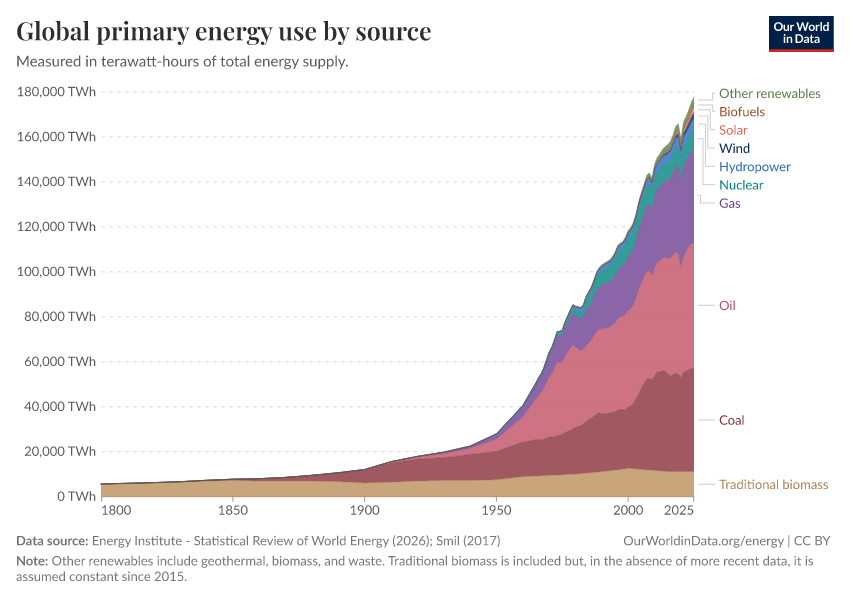
What's your plan? "Hey claude scrub the entire atmosphere to remove co2 from the past 200 years, make no mistake and use no energy"? "Hey codex send all our industries with razor thin margin to the moon, make no mistake and keep them as profitable as on earth"?
Look at atmospheric co2 scrubbers, the hot new thing, we can just keep polluting and clean it up am I right? Well, let's run the numbers:
We need 1 to 3 MWh of energy to remove 1t of co2
We produced 38.1 billion tonnes of it in 2025
Global electricity production in 2025: 30 TWh
We'd need to dedicate ~100% to 300% of our electricity production to simply offset our co2 production, even if we get it 10x better, and we won't because co2 is very stable and very dilute in the atmosphere (and also because it literally is below the minimum thermodynamic work to separate CO2 from air in ideal lab conditions), it's still completely retarded.
Every single technical solution to climate change completely falls apart when you run the numbers, the only argument left is "in the future we'll invent a magical tech that will save us so we have to accelerate"... might as well pray Jesus for help at that point
cyberax 3 days ago | parent
Meanwhile you're lying about us wiping out 70% of wildlife population in 50 years.
I already replied in the other thread why.
guitarlimeo 3 days ago | parent
- climate change is having real measurable negative impacts already
- 90% of the shit we create is useless low quality junk and e-waste with a two years life expectancy
- green washing doesn't change the fact that the vast majority of industries are not compatible with long term sustainability
cyberax 3 days ago | parent
No, e-waste is not a serious issue on the scale of climate change. It would be nice to fix it, but either way its impact is fairly minor.
And I don't doubt that most industries will be sustainable within the next 30-50 years.
233mhz 3 days ago | parent
If that's your definition of "sustainability" lmao... nothing is a problem if your horizon is 50 years
panick21_ 2 days ago | parent
His growth would go to him and then he would graceful give some 'alms' to the 'deserving poor' meaning only 'good white christens who do not advocate for anything he doesn't like'.
Peter Thiel is literally human scum of the worst kind. He literally has his hand in all destruction of modern western society, and is trying to go back to 11th century emperor aligned with a compliant pope, but extend this over the whole world.
Reason077 3 days ago | parent
For a long time (several decades) electricity demand has been decreasing in the UK, largely due to efficiency improvements. But now days pretty much everyone agrees that electricity demand will increase significantly in the future due to electrification. The UK has been planning for this for some time so if this guy was really from National Grid, he sounds like a bit of a rogue!
> "their great idea to deal with the shortage is intermittent availability of power. You won't be able to wash your clothes when you feel like"
No, nobody is suggesting that the grid will ever cut off power to anybody - certainly not domestic customers. The idea is that in a smart grid, big industrial customers often have the ability to temporarily reduce demand for heat or cooling or whatever. So if there is a signal from the grid that demand needs to be cut, automated industrial systems can (and already do) do that. The same goes for your car charging, water heating, etc. These things can automatically slow down during demand peaks in response to a signal from the grid, and you probably won't notice or care. You'll still be able to wash your dishes any time you want!
This is all definitely a good thing. A huge part of the cost of running the grid is in handling the biggest demand peaks, which might only occur for an hour or two per day a few times per year. If the peaks can be reduced and demand becomes smoother, then energy becomes cheaper.
philjohn 3 days ago | parent
And with more and more houses installing solar and battery, opting into shoring up the grid for a decent uplift in standard export rates would be of interest to many.
Kodiack 3 days ago | parent
cogman10 3 days ago | parent
The same is true about climate control. 1 or 2C from the desired temperature is still pretty comfortable but can make a huge difference in power savings, particularly if it's coordinated.
That said, I suspect that the even better route for power companies to go down is installing more grid batteries. Those can directly address and smooth out high demand. Put them at the various substations and you can shut off the main grid to the substation temporarily under high load.
DoctorOetker 3 days ago | parent
adrianN 3 days ago | parent
DoctorOetker 3 days ago | parent
cogman10 3 days ago | parent
But further, once pasteurization has occurred (which takes 2 minutes at 60C), Abiogenesis doesn't happen. A water heater can safely go down to 36C after it's hit that 60C temperature. Not that it would.
So long as your water heater is hitting 60C once a day and stays above 42C, you have very little risk of developing dangerous levels of Legionella in the tank.
edelbitter 3 days ago | parent
Once silicon is in control (which is where responding grid requests to delay consumption is more or less necessarily heading) you could even achieve better (worst-case) safety margins at reduced (total) power consumption. Because the machinery no longer needs to be designed around two "dumb" thermo switches and do a little extra in case layers of varying temperature manifest after two or more spaced periods of consumption. With continuous monitoring in software, you can integrate the worst-case bacterial growth based on time elapsed outside the "practically safe" temperature ranges. Then the tank always knows what is needed, and can both operate on tighter margins and reliably know when reducing or delaying power draw is ok.
rsynnott 3 days ago | parent
Paradigma11 3 days ago | parent
detourdog 3 days ago | parent
I have been expanding solar thermal because it’s free of both of these constraints.
https://www.iberkshires.com/story/83932/Williamstown-s-Gas-S...
H
Twirrim 3 days ago | parent
Nearly 20 years ago I had such a wonderful debugging experience when the power grid where I lived sent a "switch to backup" message and then milliseconds later a cancellation. The colo's power system got jammed between generator and mains electricity and everything rapidly ran out of UPS backup power and died. I found so many dependency loops between servers that day, took me hours to get things back up and running.
MisterMunchkin 3 days ago | parent
FridayoLeary 3 days ago | parent
Frieren 3 days ago | parent
Privatize profits, socialize costs. That is the main reason for nationalization. Western nations would not be so much in debt if they had assets. All assets were sold during neoliberal policies and the state was stripped from income. That is not going well, is it?
Re-nationalization is the only option to have solvent states.
FridayoLeary 3 days ago | parent
I hate that as well, it's anti free markets. It will always exist to some degree since infrastructure is necessary, but there has to be more accoutability. But i'm a Thatcherite in that I believe government should be as small as possible. They have no business being employers, owning property etc. Whatever they do own should be justified, and you cannot justify having a major proportion of the population and national industries and companies run by government as was the case in Britain in the 70's and early 80's.
The alternative philosophy, basically socialism and socialism adjacent ideas that all critical national infrustructure should be run by the government imho relies at it's core the idea that it's just and proper for this to be the case since the government is the collectivevoice of the people, and the government owning something is as though the citizens of the nation own it. Which is... for lack of nicer words, major copium.
Then you have the other point, which is connected with the first, that more often then not nationalized industries are terribly run. And that's by design. In some cases nationalizing something may be necessary, but that should always be veiwed as a last resort, something to be avoided.
Frieren 3 days ago | parent
Government should represent the people. To make it as small as possible just makes the voice of the people the smaller possible.
> They have no business being employers, owning property etc.
What is owned by the state is owned by all citizens. A state that owns nothing is a poor state that needs to borrow money and eventually default and fail.
> more often then not nationalized industries are terribly run
That is not true. Many countries have national corporations that run better and give better services that for profit ones. Look at the USA education system as an example of for-profit failing. The countries that run national corporations badly, are the countries that just plainly run badly, and are corrupt. Their private sector is no better that their public one.
panick21_ 3 days ago | parent
The question is sometimes, were they terrible run or did they just suffer from bad investment?
Because often they got little money but also had universal service requirements.
Badly privatizing these companies made things worse, not better. Just nationalizing monopolizes is a bad idea, as well as just smashing them into 100s of pieces and leaving behind a mess (see railways).
Also those countries that did things well, see Telecoms in the Nordics, or rail in Switzerland often did it state lead.
And ironically, for example rail required more subsidies after privatization. While also losing the amazing research and forward thinking organization that was British Rail.
I would argue improving these national industries would have been far easier and more successful then privatizing them. And ironically often cheaper.
jeromegv 3 days ago | parent
kieranmaine 3 days ago | parent
> had in mind that electricity demand should decrease
Does this mean the speaker wanted demand to decrease? The UK forecasts from the Future Energy Scenarios [1] show demand increasing (see page 21).
> intermittent availability of power.
I'm assuming this was related to demand side response. Page 37 of the Future Energy Scenarios pdf contains an overview of this.
I worked at an EV smart charging start up (Kaluza) between 2019-2022 and my experience doesn't line up with a couple of your points:
> You won't be able to wash your clothes when you feel like
During my time at Kaluza the customer could charge their EV whenever they wanted.
> you will have to adapt to when there is spare power,
The customer set their minimum state-of-charge (0-100%) and we would always have it charged to that amount by a specified time, irrespective of demand. We aimed to charge the customer's EV when demand was low (there are UK markets we can sell this ability to - these markets may have changed since I was there), which would save them money, but meeting the minimum SoC was the most important thing.
> This is just a regression in technological progress
Reducing peak demand reduces the amount of infrastructure you need and makes better use of what you have. IMO it's a good upgrade that makes much better use of the assets on the grid.
Vehicle-to-Grid (or Home) charging takes this up a level by feeding power back to the grid. This "What’s next for Vehicle-to-Everything?" PDF [2] is 4 years old now, but has some good data on V2G and the benefits it brings.
1. https://www.neso.energy/document/364541/download
2. https://info.kaluza.com/hubfs/What%E2%80%99s%20next%20for%20....
niltecedu 3 days ago | parent
scrlk 3 days ago | parent
The network operators or the system operator? Hard to do any form of sane long term planning when the regulator changes their mind every 5 years.
FridayoLeary 3 days ago | parent
On the surface it sounds like a good thing to worry about the enviroment, but in reality government policy is insane and stupid. As one example, the UK in it's wisdom don't allow North Sea oil extraction, the Norweigans do. And guess who we are buying electricity from? On top of that, the UK's overall contribution to carbon emissions are insignificant compared to China. We just pay more money for electricity for no good reason. Obviously we use less electricity, we can't afford it. And Labour enviromentalists see that as a win.
cryptopian 3 days ago | parent
France, mostly.
locallost 3 days ago | parent
coryrc 3 days ago | parent
In nearly every case, this is actually "we'll take 35% of your bill if you agree to let us sometimes turn off your A/C and clothes dryer between 5pm-8pm". It doesn't require everyone to take the deal, just enough people who want to save money. You can take the discount and use your own battery if you want, or you can pay full price so the power company can. And some will live with the mild inconvenience in exchange for money (which most of us are forced to do in so many different ways).
This is just charging people the costs of their decisions. That's capitalism at its best.
helsinkiandrew 3 days ago | parent
The UK introduced cheaper nighttime electricity (and storage heaters that could use it) - economy7 at the end of the 70’s
manarth 3 days ago | parent
One of the key challenges is electricity distribution, with a number of key transmission bottlenecks: a notable one is Scotland/England, where Scotland renewables generate more power than necessary, but not all of it can be exported to England as their isn't enough capacity across that transmission section.
Transmission capacity growth is now the key priority for the grid, with policies and plans optimised to address the bottlenecks in distribution.
dkdbejwi383 3 days ago | parent
Demand on the national grid probably should; as home solar (yes, even in stereotypically dark and cloudy UK), wind etc becomes more and more viable I think a mix of on-site and grid electricity will be increasingly common.
stymaar 3 days ago | parent
The grid operators are definitely not saying that in France, in fact they are spending hundreds of billion (€100B each for both RTE and Enedis) to accommodate for a growth in electricity consumption due to electrification, and are lamenting that the policies don't encourage electrification fast enough.
alastairr 3 days ago | parent
Curious what was actually said. I can imagine some smarter pricing incentives being put in place to move demand around. If so, you should know that versions of that have been happening for decades.
philipallstar 3 days ago | parent
orf 3 days ago | parent
arjie 3 days ago | parent

philipallstar 3 days ago | parent
dyauspitr 3 days ago | parent
jbjbjbjb 3 days ago | parent
nephihaha 3 days ago | parent
It also seems to be blessed with few natural disasters such as major earthquakes, volcanoes, larger tornadoes etc.
time4tea 3 days ago | parent
There are lots of factors that feed into this: lots of solar, batteries, more efficiency, improved insulation.
Some others: increase of heat pumps, energy poverty, reduction in industrial energy (both due to good and bad reasons)
Ultimately though, its not about how much energy per capita, its about the sources of energy, and how effectively they are used... my heat pump uses infinity more electricity than my boiler, but far more effectively uses the underlying energy source.
orf 3 days ago | parent
I guess it’s sort of a “I drive a large inefficient car and that’s a good thing” kind of situation? Excessive unnecessary production and consumption is a positive trait?
qlte 3 days ago | parent
basilikum 3 days ago | parent
skew-aberration 3 days ago | parent
The fact is, the UK has undergone a nearly complete deindustrialization in that period. e.g 'cars made per capita' is about 1/3 what it was. Domestic white goods are gone. Commercial shipbuilding is gone. Consumer electronics is gone. Domestic textiles are gone. Steel smelting (and nearly recycling) and machine tools are gone. For centuries(decades) these things were quintessentially British.
andyjohnson0 3 days ago | parent
I also wonder what the contribution of domestic solar and on-site industrial generation is? I'm a dev in a large manufacturing business and two of our three factory buildings are now covered in solar cells which power a lot of our operations. Some big industrial sites have on-site wind-powered generation too. Is that counted as generation in these stats? Or is it just manifested as reduced demand?
(Edit: added "being posted", "welcome" and "(neutral?)" for clarity)
ImPostingOnHN 3 days ago | parent
Right – those things aren't great. What's so amusing or outrageous about pointing that out?
> Nobody is planning to ration electricity suppies.
Did the link say they were? Maybe I missed it.
andyjohnson0 3 days ago | parent
By "here" I meant posts on this thread, not in the content of the article.
lazyasciiart 3 days ago | parent
dukeyukey 3 days ago | parent
andyjohnson0 3 days ago | parent
dofm 3 days ago | parent
I have no view either way (or a smart meter)
kevin_thibedeau 3 days ago | parent
holaysuns 3 days ago | parent
And FYI energy rationing has been one policy consideration for decades.
UK gov energy rationing proposal [1] 'Personal carbon allowances [2]
There's always discussion about this sort of thing, it's not fear mongering to point out that fact.
[1] https://publications.parliament.uk/pa/cm200607/cmselect/cmen... [2] https://www.nature.com/articles/s41893-021-00756-w
Jtsummers 3 days ago | parent
Trivially falsifiable statement, just read the comments in this thread:
https://news.ycombinator.com/item?id=50076266
>> But their great idea to deal with the shortage is intermittent availability of power.
In other words: rationing.
holaysuns 3 days ago | parent
You're doubling down on the misrepresentation.
There are zero references to rationing on this thread - and yet the top commenter calling this out as some kind of 'Telgraph-equ' nonsnes.
'Intermittent availability of power' - is absolutely not a reference to 'rationing' and if it were, it wouldn't be any kind of basis for hyperbole over 'rationing'.
I gave evidence of two examples of govenmental policies around rationing, and it's definitely not via 'power outages' - that's absurd - rolling blackouts only happen during emergency situations.
You've stated that the conversations has tilted to 'rationing' is 'trivially falsifiable' and at the same time haven't produced any evidence.
holaysuns 3 days ago | parent
The quote is:
"Deindustrialization has reduced demand,"
Leaving out 'Deindustrialization' is leaving out most of the story.
That is the gaph of industrial decline.
It's not that the 'dishwashers' are using less electricty so much as dishwashers are no longer designed and made in the UK. That is the story.
Probably less than 20% of that curve is 'green good news' - 80% of it is deindustrialization which is a primary economic malaise.
That deindustrialization is now starting to hit 'core' industry like auto - and a fundamental driver of the far right.
Industrial use of electricy is about where it was in the 1980s because industry ha moved elsewhere, like China.
AfD cannot get enough votes without that curve - Mercedes is closing down while China expands. That's the story.
orf 3 days ago | parent
I would call this a basic misrepresentation, but you just pulled that number out of thin air. Or somewhere worse?
50% of the decline is from industry, 50% from residential[1]. During that timeframe, industrial output increased.
1. https://www.iea.org/data-and-statistics/data-tools/energy-st...
red75prime 3 days ago | parent
[1] https://assets.publishing.service.gov.uk/media/651422e03d371...
[2] https://commonslibrary.parliament.uk/research-briefings/cbp-...
orf 3 days ago | parent
holaysuns 3 days ago | parent
All of think links here, the person you are responding to, mine (above) and your own directly point towards reduction in industrial use.
orf 3 days ago | parent
Just a thought.
gorgolo 3 days ago | parent
Two things were happening at the same time: deindustrialization and electrification. Industries and the economy used to depend more on machines and oil. That was getting replaced by reliance on electricity. If electricity generation was cheap enough, we might have seen the total energy usage get transformed one for one into electricity usage. But that didn’t happen and energy usage overall went down. That’s deindustrialization.
Of course it could have other reasons like labour costs and so on.
holaysuns 3 days ago | parent
This government data is must more substantial than that link, and it puts the ratio at 70% reduction in electricity due to deindustrialization.
Moreover - the OP's comment was a blatant misrepresentation (lie) - by ignoring deindustrialization, the primary factor as stated in the article (and in reality) - plus a bit of a thrown slander aka the 'Telegaph-esque' nonsense.
This is not Twitter.
This is not even controversial.
[1] https://assets.publishing.service.gov.uk/media/6aba96e8997a4...
orf 3 days ago | parent
The linked numbers are not per-capita, they are absolute.
locallost 3 days ago | parent
rgmerk 3 days ago | parent
To take the stupidest version of the argument (not going to sugarcoat it, I think it was embarrassingly stupid) there was Marc Andreesen's Techno-Optimist Manifesto where he called for a 1000x increase in energy production from nuclear fission and fusion. I quote directly:
"We believe energy should be in an upward spiral. Energy is the foundational engine of our civilization. The more energy we have, the more people we can have, and the better everyone’s lives can be. We should raise everyone to the energy consumption level we have, then increase our energy 1,000x, then raise everyone else’s energy 1,000x as well."
fakedang 3 days ago | parent
rgmerk 3 days ago | parent
The point of using energy is not to use energy. What matters is the services that energy delivers, be it a hot shower, a drive to the grocery store, a new house, a squillion tokens of AI computation. If we can get the services we want more cheaply by energy more efficiently, this is a good thing, not a disaster for humanity.
For completeness, I acknowledge that there are people for whom energy usage is inherently bad, which is equally silly. What matters are the downside impacts of the energy use, not the energy use itself.
fakedang 3 days ago | parent
rgmerk 3 days ago | parent
bobthepanda 3 days ago | parent
In all the places I’ve lived there are generally large incentive programs to convert air conditioners and old heaters to heat pumps, and other efficient appliance replacements, install better insulation, etc. because that rebate dollar stretches a lot further than building new power plants, transmission lines, etc.
jdminhbg 3 days ago | parent
rgmerk 3 days ago | parent
hdgvhicv 3 days ago | parent
rgmerk 3 days ago | parent
That's roughly ten times the warming effect of doubling CO2.
Now, I don't have a climate model handy to simulate this in detail but I would suggest "render the Earth uninhabitable" is a close enough approximation to the actual effects to suggest it's a terrible idea and anyone seriously proposing it should be laughed out of the room until they've done their homework.
hdgvhicv 3 days ago | parent
https://ourworldindata.org/energy-production-consumption
Most of that is lost in waste heat.
Total energy arriving on earth from the sun is about 1,500,000,000 TWh
https://smartstep.blog/how-much-solar-energy-hits-earth-per-...
7500 times higher
fakedang 3 days ago | parent
The US has a lot of wiggle room wrt energy consumption because it has ceded the role of being the world's factory to China. At the same time, the US is the world's data center and software development hub, and the world's finance hub, and the world's bank. What does the UK have in comparison?
locallost 3 days ago | parent
The US has a lot of wiggle room because it uses almost 2x electricity per capita than e.g. Germany. People don't need electricity, they need light and cooling. If you do the math, that is hundreds of GW of free "new" capacity just by getting the same value for less energy. Obviously you can't do 1/1 comparisons, a lot of people in the US use AC whereas they don't in Europe. But overall the US could get more efficient in energy use. People buy new appliances all the time, make them be more energy efficient. Or don't and let the market sort it out. "The solution to high prices are high prices".
Beijinger 3 days ago | parent
Yest it is. https://arxiv.org/pdf/0811.1855
"a fallacy that hasn't been true for decades" Nope. https://en.wikipedia.org/wiki/Jevons_paradox
Same with AI. It is becoming much more efficient and cheaper. This will result in a much, much higher demand. Expect Netflix to render a movie based on your wishes in real time.
That the energy demand is sinking is based on the fact that most industries got outsourced to China.
PaulDavisThe1st 3 days ago | parent
Blech. I don't have wishes I want netflix to fulfill. I want to see the dreams of another human before me and be entranced/enchanted.
quacktopia 3 days ago | parent
locallost 3 days ago | parent
When your logic collides with hard numbers I would stick to the numbers and reconsider the logic. Here is an idea: will I run my dishwasher 3x more often just because it is now 3x more efficient? Will I run my fridge more often because it is more efficient? Difficult, it already runs 24/7. Will I keep the lights on when I sleep because they are 10x more efficient?
So as you see although there is obviously some validity in the OBSERVATION that is Jevons Paradox, it is not a hard rule. There comes a point where it stops being true.
Beijinger 2 days ago | parent
https://ourfiniteworld.com/wp-content/uploads/2018/05/the-ap...
https://ourfiniteworld.com/2017/10/18/the-approaching-us-ene...
"Will I keep the lights on when I sleep because they are 10x more efficient?" Nope. But now you have a computer, maybe two, a cell phone, an ebook reader, a tablet, take international flights and use Bitcoin and AI.
locallost 2 days ago | parent
Article link: https://ourworldindata.org/energy-gdp-decoupling?ref=ufuksno...
Your anegdotal evidence falls on its face as well: I have two TVs now instead of one, and my electricity consumption went down. This includes moving mid year from an office to work from home. So one laptop charging every day, and one monitor. I even bought a printer which I did not have previously. That's because the two TVs combined, made 2023 and 2025, use less electricity than the one I had before, made 2011. The addition of a laptop, monitor and printer were negligent compared to the savings I made with my new fridge.
Beijinger 2 days ago | parent
locallost 2 days ago | parent
I also stated previously that we have the data even on a large scale. Electricity use in the EU went down in the last 20 years and this even with millions of EVs now compared to then. Even Norway which now for years sells almost exclusively EVs has had just a mild bump in electricity use compared to a decade before. This implies that The efficiency savings made elsewhere held. My hypothesis would be it's because at a certain point it's impossible to use something more than you already are (see fridge, dishwasher, induction stove, computers, TVs etc) and thus efficiency gains there will hold. The same pattern is observed with American gasoline use -- as the gas guzzlers of the 70s died off during the oil crisis, per capita gas use fell and practically never recovered. This despite the fact that this use case is quite comparable to coal and you could easily argue that with better mileage people will drive more. And they probably do, but still the gasoline use fell.
You argued further that developed countries need to account for energy use of products they offshored, but I offered data that says otherwise. Additionally the argument can't be used for gasoline use which as stated did not follow Jevons Paradox.
So obviously, Jevons Paradox did not hold in these substantial cases and should not be viewed as law of nature. It's an interesting observation that makes sense, but obviously has its limits.
wmf 3 days ago | parent
JdeBP 3 days ago | parent
* https://rac.co.uk/drive/news/electric-vehicles-news/1-in-3-n...
teamonkey 3 days ago | parent
Air conditioning is a weird one, because it’s only been necessary in residential properties for a couple of years, and really still only necessary for a couple of days a year, so a fixed installation isn’t cost effective. Portable units are becoming more popular.
AC has been a requirement in most commercial premises for years. Decades, perhaps.
wildzzz 3 days ago | parent
Muromec 3 days ago | parent
dghlsakjg 3 days ago | parent
From a pedantic point of view, it is quite literally the exact same as an AC. Air conditioners are literally heat pumps.
IanCal 3 days ago | parent
Common installations reuse the wet systems we have and are air to water, which was until recently the only thing the grants covered (and now it’s still lower for a2a).
rcxdude 3 days ago | parent
CivBase 3 days ago | parent
pornel 3 days ago | parent
Muromec 3 days ago | parent
Most importantly it's not the same in the way of me not feeling the chill. It's stupid, as I know the house is cooler than the outsides, but the actual split system delivers the cold air right to where I feel it and this thing just makes the ambient temperature down to 25c without me even noticing.
I don't want to know what it costs to install (I got it with the house), but split system costed lol nothing in eastern european dollars and took some guys less than half a day and zero permits to install too. For better or worse the heat pump doesn't live in the same locale I had that.
vel0city 3 days ago | parent
This is more like what they're talking about, but they do come in a lot of shapes and sizes and can be more or less integrated into central systems.
Muromec 3 days ago | parent
throwthrowuknow 3 days ago | parent
thewonderfulmrp 3 days ago | parent
ben_w 3 days ago | parent
Like, sure, but the word has a specific and a general meaning, conventional use is only the specific meaning.
legulere 3 days ago | parent
With an AC the advantage is that the condensate is forming inside the AC when cooling the air.
manarth 3 days ago | parent
Although you could pipe cool water through the radiators, it's an ineffective form of cooling compared to blown-air systems, and retro-fitting a blown-air system is much more costly than a heating-only heat pump.
throwawayffffas 3 days ago | parent
jonasdegendt 3 days ago | parent
Once room and floor temperature match, condensation doesn't occur anymore as long as you keep it running.
walthamstow 3 days ago | parent
nickserv 3 days ago | parent
However it will not cool like an A/C unit, only something like 5°C reduction. This can be enough to get a decent night's sleep during a summer heatwave.
walthamstow 3 days ago | parent
mitxela 3 days ago | parent
multjoy 3 days ago | parent
While our house is relatibvely small and we kept the units (which also do heating as well) confined to the main living space, it wasn't especially burdensome. The bulk of the work was installing the behemoth of a hot water tank!
adaml_623 3 days ago | parent
nothercastle 3 days ago | parent
adaml_623 3 days ago | parent
I'm currently investigating options for kitchen sinks and such. It feels quite silly to have a long length of pipe leading from a central source for a small amount of warm water to wash my hands.
multjoy 6 hours ago | parent
Daikin (and presumably others, but they're the ones we went with) do have integrated tanks/heatpump internal units. It might be worth having a think about your actual needs and it may be that there is a solution.
My experience with electric hot water taps is that they've been universally awful and only a last resort, but equally the state of the art may have moved on since I last looked!
mitxela 3 days ago | parent
imp0cat 3 days ago | parent
This is only the beginning. Soon people will realize that a mini-split install isn't that much more expensive than a portable AC, but is a lot more convenient.
peterbecich 3 days ago | parent
JBits 3 days ago | parent
The UK typically doesn't need air conditioning, so why would people spend money on it? Yes, I know this recent summer was exceptionally hot but people don't react that quickly to changes.
> decarbonizing heating
What does this mean? More renewables? If efficiency reduces energy demands then it directly results in less carbon.
> electric vehicles
Aren't people already adopting electric vehicles? Do you think that the government should introduce a scheme to persuade people to buy electric vehicles? Does the availability of charging for electric vehicles need improving?
> Efficiency is good after you have high living standards but the UK should probably focus on growth first
Efficiency means saving money. In what circumstance could efficiency be bad? The grid responds to demand, unused electricity means higher prices for consumers. One of biggest issues right now in the UK is cost of living crisis, so raising electricity prices would be universally hated. How does making the grid less efficient increase growth?
_jackdk_ 3 days ago | parent
I believe this refers to switching to high-efficiency electric heaters like reverse-cycle AC units (also known as "heat pumps"), rather than oil heaters or ducted gas heating.
teamonkey 3 days ago | parent
Decarbonisation usually means replacing that boiler with a heat pump which uses electricity to heat water.
_jackdk_ 2 days ago | parent
zarzavat 3 days ago | parent
I don't know where you live but UK summers were unbearable even when I was a kid. Buildings are engineered to trap heat, so the heat doesn't dissipate at night and every day the indoor temperature rises, and rises...
At least they removed the need for planning permission recently. The problem is that the places that need AC the most (flats) will probably not be able to get it until the leasehold system has been abolished.
> > decarbonizing heating
> What does this mean?
Presumably it means heating using electric heat pumps rather than gas boilers. This also solves the AC problem. I don't think this is viable for most people. Heating was never the problem anyway, at least in the south winters are mild.
zabzonk 3 days ago | parent
well, i live in lincolnshire and used to live in london. i usually have a fan on for a few weeks over summer, but that's it. where in the UK did you live that the summers were so unbearable?
expedition32 3 days ago | parent
mohamedkoubaa 3 days ago | parent
Muromec 3 days ago | parent
MayeulC 3 days ago | parent
avhception 3 days ago | parent
KaiserPro 3 days ago | parent
Not to be that guy, in the last 20 years, 27 was considered a heatwave.
> Buildings are engineered to trap heat,
I mean Victorian buildings were engineered to let in light, and have good ventilation. Hence why each room has a huge sash window, an airbrick and a fireplace.
moebrowne 3 days ago | parent
This makes insulation sound like a bad thing. The more insulation you have the less the indoor temperature is affected by the outside temperature.
adaml_623 3 days ago | parent
zarzavat 3 days ago | parent
Insulation isn't magic, over many days of hot weather eventually the building will reach equilibrium with the average outside temperature. This means it will be cooler indoors than outdoors during the day, and hotter indoors than outdoors at night.
However, the nights are specifically when you want a residential building to be cooler, assuming the inhabitants are not at home during the day. So the insulation actually makes the building hotter from the perspective of the inhabitants.
Dylan16807 3 days ago | parent
drnick1 3 days ago | parent
Nobody "needs" air conditioning, but even a modest window unit provides a huge improvement in quality of life whenever it's 80+ outside.
Muromec 3 days ago | parent
autoexec 3 days ago | parent
It can be considered a medical necessity for people with certain conditions like anhidrosis, asthma, COPD, kidneys disease, or cardiovascular issues. It's also a huge medical benefit for people with terrible allergies who wouldn't be able to open a window even when that'd normally help cool the house.
IanCal 3 days ago | parent
We are? It’s becoming more common and we had a few bad summers and earlier this year too. The heat wave a few years back killed my dad.
Given there’s a push to swap heating systems for more efficient ones, air con units are being looked at a lot more.
gib444 3 days ago | parent
We had 6 heat waves this summer. Parents were booking hotels just to keep their kids cool
We also had heatwaves in 2022, 2021, 2019, 2018. 2024 wasn't bad but was still the 4th hottest year on record.
You can absolutely bet the better-off middle classes are installing aircon. I know many. If more people could afford it they would get it
It's the humidity too not just the heat. And how after 3 or 4 days of high temps, our houses just do not cool down at night because they act like radiators. Humid 25c+ nights suck for us
doctorpangloss 3 days ago | parent
hdgvhicv 3 days ago | parent
I’m thinking about it, but there’s a lot of other things I could spend the capital on.
Reason077 3 days ago | parent
The UK is definitely doing all three of these things. Though arguably not fast enough, for some of them.
rcxdude 3 days ago | parent
youngtaff 3 days ago | parent
BEV is 28% of new car sales HEV is 13%
to11mtm 3 days ago | parent
- CRTs got replaced by LCDs, and LCDs even 25 years ago were maybe around half the wattage
- CFLs and then LED Light bulbs replacing older filament bulbs.
- The switch from desktop PCs that might take 100-200W before even considering the screen, to Laptops that might use 50W on average.
With the smaller thought of:
- Set-top appliances like rice cookers and air-fryers that tend to be better for smaller everyday cooking than a full-on oven or stovetop.
And it's fun to think about, e.x. I remember when I had to move back in 15-ish years ago my parents (very politely!) complained about the power bill increase until I went ahead and did the one-time cost of switching all the bulbs I could to LED. That change alone managed to cover the PC, monitors, and TV I had at the time.
Realistically, your average citizen is using less power than they were even 40 years ago, even with all the additional technology they have.
adventured 3 days ago | parent
That also goes for people watching things on their smartphones instead of a 65" television.
to11mtm 3 days ago | parent
Even people who have laptops, the shift to smartphones and tablets for much (maybe most? IDK I'm still a laptop person at minimum when I write this so it's hard to say) of their computing/communication is another order of magnitude change for sure.
As another side note/anecdata, I still remember the amazement where the aftermath of a nasty (mostly wind) storm in 2017 caused major outages in my region. I had just moved into an apartment and due to the lagging maintenance around makeready/treetrim it took the better part of a week to get power back. Thankfully however, I had a fully charged, fancy-ish APS Backup unit [0] that was able to keep my Surface Pro 3 and 4G Hotspot charged enough to at least not feel totally in the dark. It was crazy to see how even with both charging the 'time remaining' indicator said I could have used both way more than I even needed to.
[0] - Some variant of an APS 1500VA
wildzzz 3 days ago | parent
SoftTalker 3 days ago | parent
hdgvhicv 3 days ago | parent
ekidd 3 days ago | parent
Haven't burnt out a single bulb yet.
I understand that this has caused some challenges for the Philips Hue division. They had extremely satisfied customers but not many repeat buys.
rsynnott 3 days ago | parent
It costs 6 euro. I'm _fairly_ sure that incandescent 100Ws didn't cost six cents. I bought a few of these (actually a cheaper non-dimmable model which is no longer on Ikea's confusing website, from a cursory search) in 2016, when I moved. They're still working fine.
Whereas incandescents failed _all the time_.
murkle 3 days ago | parent
SoftTalker 3 days ago | parent
Throughout the house, I need to replace a regular screw-in LED bulb probably every other month or so. I don't know what brand they are, they are light bulbs I picked off the shelf at Target or Walmart. Life is too short to worry about light bulb brands. Until now.
rsynnott 2 days ago | parent
Well, yeah, because they were trying to get rid of them.
> Life is too short to worry about light bulb brands
Just get the Ikea ones, they're fine.
alerighi 3 days ago | parent
Beijinger 3 days ago | parent
leonidasrup 3 days ago | parent
The total electricity consumption for computers is much higher then in the past. You just don't see it, because the consumption moved to data centers.
alerighi 3 days ago | parent
To me the difference is that we moved to more efficient ways to generate heat, more specifically from electric resistive heating to heat pumps. Both in home heating but also appliances (e.g. cloth driers).
And of course there is climate change, not only we generate heat more efficiently (an heat pump uses at least 1/3 to the power to generate the same amount of heat) but also the climate is less cold, thus less heat required. That is the big difference, not bulbs or computers.
Of course for nations that are more hot in the summer (e.g. my, Italy) the reverse applies, that is more power used because of air conditioning, that 30 years ago nobody had and now it's required since last summer was 25/38C outside for 2 months straight.
toyg 3 days ago | parent
Germany saw a massive drop too. The only big European country that keeps growing their electricity production is France.
roenxi 3 days ago | parent
If I search for "retail electricity price trends uk" I'm starting to see reports coming out of the UK like "UK electricity prices are now among the highest in the developed world." and "Household electricity prices have risen by almost 150% since 2010, and business electricity prices by nearly 175%" [0]. And now we see things like they've dropped below their 1970s per capita consumption.
That looks like rationing. Economies ration by raising prices until poor people can't consume as much. It doesn't sound like an efficiency gain. Mathematically speaking efficiency gains should actually involve people using more electricity [1] because there if it was worth spending that much money for X stuff now it makes even more sense because you can get >X stuff. It looks like they don't have enough energy and people are getting squeezed. I'd expect to see political instability in such an environment but the last time I checked only one of the major parties seemed to be in the process of collapsing (down from 2 in April) so they are doing better than expected on that front; I would expect riots in the streets with these sort of trends.
Dylan16807 3 days ago | parent
Light bulbs got 6x as efficient and roughly nobody wants 6x as much light.
Most appliances don't see much increased use from efficiency. And air conditioners have had pretty stable efficiency; other factors drive use changes there.
throwthrowuknow 3 days ago | parent
Dylan16807 3 days ago | parent
duskdozer 3 days ago | parent
avhception 3 days ago | parent
Very appropriate nickname!
dghlsakjg 3 days ago | parent
adrian_b 3 days ago | parent
Where I live, in Europe, when I was a child there was a great abundance of insects of many different kinds. If I did a walk around my home I could see insects from perhaps at least 10 different orders.
Nowadays, the only insects that are still abundant are the true bugs (Hemiptera) why all others have mostly disappeared (a few, like mosquitoes, may still be seen from time to time). I do not know the reason, but I assume that the true bugs might be more resistant to insecticides.
noir_lord 3 days ago | parent
I think the number of lights is about the same at least where I live in the UK, the big change is the light is now bright white not the yellow of the older sodium vapour lights.
I kinda miss that but mostly because it wasn't as bright and is what I grew up with, you can't really argue that the white light isn't more effective at it's primary goal (illumination) though.
bluGill 3 days ago | parent
IN fact white light is MUCH MUCH less effective. Red light doesn't affect your night vision, and yellow isn't much behind. White light means you can see very well where the light it, but you can't see beyond that radius and so more light is needed. I don't need to see colors at night (where white it good), I just need to see the dangers in time to avoid them, and so white is much worse for the goal.
Just to make it worse, it takes nearly an hour for your eyes to fully adjust to dark after leaving white light. So if the lights go off or you have to leave the place where they are shining you can't see as well.
White light is only good when you have enough of it that everything you want to see for the next hour is fully illuminated. If there is any exception to that, then you shouldn't have white lite.
close04 3 days ago | parent
We got an increase in lighting whether we like it or not but for lower overall consumption.
> not to mention headlights
40 years ago the highest powered headlight halogen bulbs consumed 80-100W per bulb. so you were looking at 150-200W for low/high beams. A pair of modern laser headlights now gives you 5 times more light for a fifth of the electricity. The limit is safety in traffic. A misadjusted 200W laser headlight will leave you short of 2 retinas.
> People also seem much less concerned with leaving lights on in unused spaces as well.
They consume so little that even wasting is still cheaper lower consumption than in the days of incandescent lights.
roenxi 3 days ago | parent
Dylan16807: Light bulbs got 6x as efficient and roughly nobody wants 6x as much light.
We're saying the same thing, but my spider senses are detecting we aren't on the same wavelength. Maybe if I point at the key words, that will help?
And while I'm thinking about it, let me recommend those heating bathroom lights. They are divine.
close04 3 days ago | parent
You concluded rationing before having evidence of real demand in the sense of need or even desire from the people. The less data you have, the more potential answers fit in the gaps.
Do people overwhelmingly need or want more electricity and can't afford it? Or do they already get more but with less electricity? I get twice the light I had 20+ years ago with a third of the electricity consumption. I get way more computing power with less electricity too. Same with my TV, my fridge, etc. Excluding the switch from gas powered kitchen appliances which drove my electricity consumption up, everything else went down in consumption while giving me more.
Do I mathematically want or need more? Am limited by the price of electricity, or by the price of the bigger/better product? Maybe I'd want a walk in fridge or a 3m tall TV but the electricity isn't the limiting factor. I need an extra room and taller ceilings first. Do I want more light? No. Do I need any of the things I mentioned? Also no.
The increase in price could equally be the providers extracting the maximum value from the consumers. Current consumption could be exactly as much as the consumers want or need to consume, and the providers sell for as high as they can before that demand drops. We need more data to answer this and we don't have it now. So your answer is your bias put in words, not the certainty you want to make it sound like.
The biggest consumers which dwarf the stove are industrial ones. And there the drop is real. Manufacturing moved abroad and electricity production moved with it. This is what the numbers of the article shows and it's hard for consumer demand to compensate, except maybe with mass EV adoption.
Citizen_Lame 3 days ago | parent
close04 3 days ago | parent
Because the comment triggering this branch suggested improvements in efficiency must imply wanting to consume more. Light is one of those things, where the rule doesn't automatically apply. It's not the only thing I mentioned, you just chose to skip the others to make your job of arguing easier.
> Heating, cooking and appliances use the most
Even there you get more for less. Induction stoves are way more efficient than the old heating elements but do you want to spend more time in front of the stove because the electricity is cheaper? Some times, but not that common. Heat pumps are way more efficient than a boiler but it doesn't guarantee that you want hotter shower water or warmer room. But more importantly, most heating isn't electric. Natural gas, oil, or wood were always far more common. In the UK today almost 75% of heating is gas. Electricity is less than 10% [0] so it contributes little to the topic of the article.
Now let's get to the confounding factors which go down the pit of ignorance. Natural gas was always subsidized almost everywhere in the world whether you know it or not. District heating is more of the same. Where I live there are still "heating electricity" plans so people get a better price if they happen to use electrical heating because the provider knows that small number of people will suffer compared to others.
Another confounding factor, the push for extreme efficiency. Heat pumps have some big limitations that nobody wants but choose to live with for the sake of efficiency and self sufficiency. Because people also install solar panels on their roof and power their appliances without anyone ever reporting how much more heating or cooking was provided with 0 load on the grid.
In reality the biggest consumers which dwarf cooking appliances are industrial ones. And there the drop is real. Manufacturing moved abroad and electricity production moved with it. Maybe mass EV adoption can push the demand/production line back up.
> Seems like you don't live in the UK.
You are correct, I do not. This shouldn't prevent me from having an informed opinion though. Much like how I can write to you in English without living there.
[0] https://commonslibrary.parliament.uk/research-briefings/cbp-...
whycombilater 3 days ago | parent
I see things stated (and assumed as a norm) by people in this thread that are just miles off.
If you're working off data and not assumptions though, fair enough.
Dylan16807 3 days ago | parent
It used to not be!
leonidasrup 2 days ago | parent
It is historic, electric lighting was the first major application for electricity in households.
" Electric lighting is highly desirable. The light is much brighter than oil or gas lamps, and there is no soot. Although early electricity was very expensive compared to the 21st century, it was far cheaper and more convenient than oil or gas lighting. Electric lighting was so much safer than oil or gas that some companies were able to pay for the electricity with the insurance savings. "
https://en.wikipedia.org/wiki/Electrification#Benefits_of_el...
roenxi 3 days ago | parent
Well, yes? That seems somewhat uncontroversial? There are a lot of people out there who need more electricity and can't afford it. Electricity is one of the most fungible forms of energy, with infinite electricity we could all live like kings. It'd be very comfortable. The limit on use is the supply-demand balance represented by prices and if price were low enough people would up their living standards.
That is also the explanation for a lot of the issues your post goes to. If you don't need to use the electricity, someone who is struggling can use it instead. And the way the math shakes out is it'd normally be economically optimum to increase their access to a good standard of living by giving them more energy than you gave up. These effects are over the entire economy.
And I do want to plug what Citizen_Lame said in a sibling comment, the obsession with lightbulbs whenever energy comes up is a bit odd. If I were relying on HN comment threads I'd believe households in the UK were composed of nothing but light-bulbs and consumed nothing but the same given how much of a focus they are of the energy policy.
watwut 3 days ago | parent
Dylan16807 2 days ago | parent
Thinking about what happens when prices approach zero makes it hard to make realistic predictions. Yeah infinite power would change everything, but for realistic price shifts there are very different price elasticities for different use cases.
And one person changing their power use doesn't do much to the price, and a large group gradually changing their power use doesn't do much to the price either. So the idea of "If you don't need to use the electricity, someone who is struggling can use it instead." is misguided. The person who's struggling is going to see basically the same price either way. If we want to help them, conserving power won't do the trick outside of specific supply emergencies, we need other measures.
Also roenxi I mentioned things other than lights, but lights happen to be a super clear example of Jevon's paradox not happening over a very significant amount of power usage so of course they'll get brought up.
leonidasrup 2 days ago | parent
Cost of electricity is a significant part in aluminum production. Cheap electricity, cheap aluminum, more cars made from aluminum instead of currently cheap steel.
Cheap reliable electricity would enable cheap hydrogen production, which could replace many uses of fossil fuels. Cheap hydrogen, cheap ammonia production, cheaper nitrogen fertilizers.
lenkite 2 days ago | parent
Speak for yourself. The price of electricity immediately & directly effects the setup/operation of small business. I know home businesses (juicing plants) that became non-viable on the basis of electricity alone.
close04 3 days ago | parent
> And I do want to plug what Citizen_Lame said in a sibling comment, the obsession with lightbulbs whenever energy comes up is a bit odd
I think you want to distract from not making your point. But easy, light used to consume a lot. By some statistics [0] just a few decades ago it was ~10TWh, close to 15% of household consumption, which in turn was higher than industrial consumption (1.1:1). So lights consumed ~8% of UK electricity. Is 15% in a household or 8% for the country so insignificant that mentioning it is ridiculous?
Personal anecdata, I can use more energy but I realistically (not in "infinite energy" world) want and need exactly as much as I use.
[0] https://www.academia.edu/81562463/Energy_consumption_in_UK_h...
roenxi 2 days ago | parent
Supply/demand and prices are rationing. Prices represent the limit on how much of a resource someone can use before there is reason to believe they should stop. It's happens to be best form of rationing we have, the other methods tend to lead to disincentives to improve the situation (consider, for example, how the market rations out limited supplies of RAM right now - prices go up and people who pay get the RAM and all the money going to RAM producers gives them resources and incentive to build new capacity to produce more RAM). There isn't a limit on demand for electricity other than the price, it does literally everything. At the extreme case, if it were somehow cheap enough, we'd be able to use it to fabricate new matter. But every step of the way there are population-level opportunities to use more energy to get more comfortable if there is enough of it.
Dylan16807 2 days ago | parent
roenxi 2 days ago | parent
But when prices go up 100-200%, that suggests the market is rationing pretty hard.
nothercastle 3 days ago | parent
bluGill 3 days ago | parent
All the things I see that would allow me to use more electric are not worth it - I'd rather spend my money on something else. My life would be better for an electric animated sculpture in my front year - but not by nearly enough that it would be worth building and so I don't have it.
gadders 3 days ago | parent
It's more what it enables in terms of industrial production, and transportation and the knock-on effects from that.
bluGill 2 days ago | parent
Dylan16807 3 days ago | parent
And that doesn't happen at all with light bulbs. The cheapness caused a mild increase in lighting, but people are using way less electricity on lights now.
roenxi 3 days ago | parent
Seriously https://en.wikipedia.org/wiki/Jevons_paradox has a pretty good explanation. This isn't a new effect, it's been an established consideration related to energy efficiency since the 1850s.
Dylan16807 2 days ago | parent
Jevon's paradox is when a specific use case gets more efficient, so you do more of that use case, so much so that the extra use overwhelms the efficiency. It happens in many situations but definitely not all. You have a curve between how much you use and how much value you get, and the steepness of that curve decides Jevon's. For lighting in the past few decades, there's no Jevon's. The changes in light bulbs have caused a big reduction in electricity use. If we were stuck on incandescents we'd be using a lot more electricity total.
roenxi 2 days ago | parent
The UK doesn't look like it is experiencing an efficiency utopia; it looks like it has a relatively poor population among the developed countries (per capita) and they're suffering from an advanced energy shortage. The costs appear to be going crazy, they're deindustrialising. That isn't efficiency. It looks like they ran out of coal and are suffering from an energy squeeze.
Dylan16807 2 days ago | parent
That's still the Jevons paradox.
> There isn't any reason to use less energy; if there are efficiency improvements then all else equal it makes the most sense to produce the same amount of energy and trade the excess into higher real living standards. Economies are good at sniffing that equilibrium out.
Massively wrong. Using more energy gives you sub-linear returns in value; you already got the lowest hanging fruit. For many uses you ramp up and use more power than before, but many uses you let your power bill drop.
-
To put it differently, read your own article. Right at the top it says "if demand is sufficiently price elastic".
Demand is often not sufficiently price elastic.
roenxi 2 days ago | parent
There is no way that the dropping per capita energy efficiency in the UK is being driven by efficiency gains, there is no theoretical reason to expect the two to pair up in the first place and it is clearly an energy squeeze when you look at the situation in context of the political and other real economic indicators. If the UK could drop 33% of its electricity use while maintaining a healthy economy that'd be a miracle on par if not exceeding what China managed in the last 50 years. That is simply not the situation, nobody seems to be talking about the vast improvements to QoL being driven by their vast surplus that has theoretically developed in the efficiency scenario [0]. Any industry that needs electricity is considering leaving. As I learned in this comments section the UKians are literally rioting in the streets which is, sadly, not a surprise given their energy statistics and the head-in-sand strategy that seems to go hand in hand.
[0] I also feel great temptation to allege that people in the UK have been forced into straits so dire that they subsist on a diet of lightbulbs, but my will is strong.
Dylan16807 2 days ago | parent
> There is no way that the dropping per capita energy efficiency in the UK is being driven by efficiency gains
I don't want to get too far into that analysis. I just really dislike how you came in here talking about Jevons like it's a guarantee in every situation. And dressing it up as "mathematically speaking". That math only applies for specific shapes of demand curve. Whether or not the UK is seeing a squeeze, your original argument and a lot of the followups were deeply flawed.
roenxi 2 days ago | parent
If there is evidence that the country has freed up a third of its electricity for other uses and just run out of things to do with it then that is going to, without doubt, be one for the history books and would be a level of success that would be well worth talking about. The signalling out of the UK isn't "we're swimming in electricity, what do we do with all this power now that more efficiencies have been found? Lets go bitcoins and aluminium to find a use for these power plants!", it'd a pretty clear "we can't produce as much electricity as we once did, we don't have the resources, usage has to drop, heavy industry please leave".
Dylan16807 2 days ago | parent
But let's say the cost of Y (in electricity or money) drops 25%. If that makes people consume 60% more Y, then spending rises. But if it only makes people consume 15% more Y, then spending drops. Both results are plausible.
There's no mathematical reason to assume the demand increase is bigger than the price drop.
If I could suddenly make each gallon of household water use go 10x as far, I'd do somewhere between 1-2x as much stuff with water as before. This would mean I'm only consuming 10-20% as much water as before. Would you be different? Again just household use, don't try to stretch the premise too far.
rcxdude 3 days ago | parent
reorder9695 3 days ago | parent
madaxe_again 3 days ago | parent
As for gas or oil boilers - oil is uncommon except in rural areas - gas is far more common but not as ubiquitous in the past as you’d think - many folks heated their homes with resistive electric radiators or IR heaters - so a heat pump is a huge efficiency win.
dgacmu 3 days ago | parent
1950: Lighting was 30% of total electrical demand [1] 1993-1997: 112 TWh, 9% of demand [2] 2020: 81 TWh, 6% of demand [3]
Couldn't find total used in 1950 but the point remains: Lighting used to be a major source of consumption and now it's pretty minor, and at least the trends in the last 30 years have been driven by efficiency gains, particularly following the energy crisis in the 70s.
[1] https://www.researchgate.net/publication/222531686_Exergy_po...
[2] https://eta-publications.lbl.gov/sites/default/files/lbnl-40...
KaiserPro 3 days ago | parent
I mean not really.
Old aircon was off/on which mean that at temperatures near the target efficiency drops. (as in turning on for a few minutes, it takes a while to move the settle heat around)
Moving from fixed speed ac motors to "inverter driven" (brushless motors) means that AC can be run at a speed other than 100% or 0%. Yes, CoP hasn't increased 6x, but newer aircons have higher CoP over a wider range of temperatures.
moving from Plasma TVs to LED/oled is about a 2-3x improvement in efficiency.
Laptops are anywhere between 2 and 10x less power than desktop (caveats apply)
then double glazing has a large effect on heat rejection/storage. Non-coated glass lets in something like 1kw/m2 of heat, coated glass can reject anywhere up to 70% of that.
account42 3 days ago | parent
adrian_b 3 days ago | parent
An old 100 W incandescent bulb produced about 1500 lumens, and now a LED bulb of 12 or 13 W can produce slightly more than that.
In the now distant past, I used only 100 W incandescent bulbs, all of which had been replaced more than a decade ago with 13 W LED bulbs, so I have benefited from this 8x reduction in energy consumption.
The other significant reduction in electrical energy consumption happened when I replaced a many-decades-old refrigerator with a modern high-efficiency refrigerator.
Compared with a half century ago when I was a child, now I consume additional electrical energy with some computers, one or two of which are almost always on, and with a microwave oven used for cooking, but the additional energy consumption is normally less than what is saved by modern lighting and refrigeration technologies.
xyzzy123 3 days ago | parent
ezequiel-garzon 3 days ago | parent
xyzzy123 3 days ago | parent
40 years of technological progress and prices went up :(
andyjohnson0 3 days ago | parent
Now in 2026 the main generators are EDF (French state owned), RWE (German), and Scottish Power (Spanish owned). These companies tend not to publish executive pay, but back in 2012 the CEO of EDF in the UK was being paid £1.2 million a year.
I would submit that all this has some bearing on why the prices have gone up.
epistasis 3 days ago | parent
This is why distributed solar is actually cheaper than utility scale solar all-in: you need less of that very very expensive grid, even if you pay 3x on the initial install costs.
mrob 3 days ago | parent
I want more than 6x as much light as I had in the incandescent bulb era. Indoor lighting is usually very dim compared to outdoor lighting, and that makes it harder to see things. As I get older and my eyes degrade I expect I'll want even more light. People running offices understand this and provide more lighting than typical for homes. See:
watwut 3 days ago | parent
michaelbuckbee 3 days ago | parent
dijit 3 days ago | parent
arrowsmith 3 days ago | parent
Yes, that means we can use the energy we would have used on light for other things.
lawsthro0532 3 days ago | parent
chii 3 days ago | parent
Consumption of final products, and exports are what make more sense to look at to see if lives are better today than the 1970's, which the article implies it isn't.
gargan 3 days ago | parent
arethuza 3 days ago | parent
https://alvancebritishaluminium.com/
Which has it's own hydroelectric scheme:
leonidasrup 2 days ago | parent
Cost of electricity is a very significant part of production costs of aluminum, around 30% on average.
pjc50 3 days ago | parent
We import very little Al from China; it turns out mostly to come from the UAE, which will have absolutely terrible CO2 emissions, as well as greener countries like Iceland and Norway.
It looks like we need to invest in local recycling (which, yes, needs cheap energy, but not as much as primary Al) in order to make more of a circular economy rather than just exporting vast volumes of scrap.
zahlman 3 days ago | parent
manarth 3 days ago | parent
Climate change and oil use have generated predominantly non-violent protests.
Palestinian rights have generated direct action protests but not riots.
Energy hasn't really been on the radar (except in the context of climate-change protests).
valesco 3 days ago | parent
multjoy 3 days ago | parent
pjc50 3 days ago | parent
It's just an immense right wing noise machine which makes it impossible to actually focus on finding solutions. We're back to people who want to improve electricity per capita by decapitating people.
People hate electricity prices, but they hate electricity infrastructure as well. They hate pylons, they hate renewables, they hate nuclear. People hate pollution and hate anti-pollution measures (see the LEZ insanity). Every solution will encounter angry blockers, often angry about things that aren't even real (anti-5G lunatics). And they want to blame everything on foreigners. Absolutely childish behavior of our """elite""", the dead hand of which sits on our media and most of our parties.
I think everything that needs to be said in this thread probably already has been by someone. Re-litigating the same issues.
amiga386 3 days ago | parent
Try this out. Have the government mandate that everyone buy a certain type of car/van. Tell them it's good for the environment and give them tax incentives to do it. Then, years after everyone's invested in that type of car/van, have the government ban that type of car/van in major urban centres. Tell them to throw the car/van away and buy another one.
And tell them that if they don't do that, you'll fine them every day, when they drive to the place they've been driving to all their adult lives for work, etc.
Announce that this applies to everyone at the same time, so there's near-zero resale value in the old type of car/van, and there's massive demand pushing the price up for the new type of car/van.
Most people don't have a spare £20,000 kicking about, and if they did, they wouldn't choose to spend it on that. Throwing away their existing car/van and buying another doesn't give them £20,000 of value. It gives them £0 of value. They already had a car/van. It might give some kids' lungs value, but not them.
Honestly, try it. Try forcing millions of people into spending a lot of money all at once, and see how popular you are. Bonus: now try blaming social media or some other fifth column for your unpopularity!
pjc50 3 days ago | parent
When I say radicalized, I mean this guy: https://www.cps.gov.uk/national-news/news/updated-sentence-m...
manarth 3 days ago | parent
> "The ULEZ camera had already been cut down"
youngtaff 3 days ago | parent
Those opposing ULEZ conveniently ignore the Conservative government led by Boris Johnson (ex mayor of London) made ULEZ implementation a key requirement for supporting TfL funding during the pandemic
Despite anti-ULEZ folk claiming it's hugely unpopular Kahn convincing won the next mayoral election including some boroughs that were affected by the ULEZ zone expansion
amiga386 3 days ago | parent
I think you overstate this. While there are wingnuts on Twitter who hate Khan for who he is, massively more people hate him - any politician, not just him - for dipping into their pocket and taking their money. "For the greater good".
Even the most beloved politican on the planet will become the most hated as soon as the propose increasing taxes, or increasing household costs. Which is why they're always looking for the sneakiest way to do it.
> Those opposing ULEZ conveniently ignore the Conservative government led by Boris Johnson (ex mayor of London) made ULEZ implementation a key requirement for supporting TfL funding during the pandemic
Alternatively, the central authority with all the money (Johnson's government) tells the devolved authority (Mayor of London) it doesn't like handing out free money, so what if our lockdown has decimated your cashbox income... so in exchange for money now to keep the lights on during this pandemic, I demand you make more of your own money in future, by fining people and by driving up public transport usage in your area. Also, I know how unpopular it is, which is why I delayed it when I was Mayor of London, so good luck at the polls ha ha!
> some
"some" indeed.
youngtaff 2 days ago | parent
Well he flipped one of them from Conservative and didn’t lose any of the ones that had previously voted for him and his vote was up overall
amiga386 2 days ago | parent
https://en.wikipedia.org/wiki/2023_Uxbridge_and_South_Ruisli...
> Both Labour's leader, Keir Starmer, and deputy leader, Angela Rayner, blamed opposition to ULEZ, with Starmer suggesting the Labour London Mayor Sadiq Khan should rethink the policy. Khan defended the policy and Starmer soon sought to heal the rift. The defeated Labour candidate, Beales, also criticised the ULEZ policy.
So someone paid the electoral price for Khan's policy, it just wasn't him.
youngtaff 1 day ago | parent
Yes, in 2023 ULEZ was a campaign issue but so was it when Khan was reelected mayor and Labour won a general election
ULEZ is fundamentally a good thing whether you like it or not
mitxela 3 days ago | parent
manarth 3 days ago | parent
In general, diesel vehicles are more likely to exceed the emission threshold.
amiga386 3 days ago | parent
So a lot of people moved to diesel cars/vans from 2001 onward.
Then in 2019, the Ultra Low Emission Zone was set around central London, which issued daily fines to:
- petrol cars/vans that didn't meet Euro 4 standards (most vehicles pre-2006)
- diesel cars/vans that didn't meet Euro 6 standards (most vehicles pre-2015)
This didn't bother that many people, because central London already has a daily congestion charge, so anyone taking a vehicle in there already had business to justify it. Most people get around central London by train/tube/bus/taxi, it's the best served city in the UK for public transport. There was also a scrappage scheme offering up to £9500 for replacing the vehicle.
What bothered a LOT of people, though, is the widening of the ULEZ area, first to the inner London orbital in 2021 and then to the whole of Greater London (9 million people) in 2023, regardless of whether they went to central London or not. The outer boroughs, aren't as well served by public transport as central London is, and car/van ownership and use is much higher than central London. And of course, the scrappage scheme was cut down to a maximum of £2000, which is not a lot.
You can perhaps see why there was so much opprobrium.
youngtaff 3 days ago | parent
Kahn won the next election including outer boroughs that were affected by the ULEZ expansion
https://metro.co.uk/2024/05/04/map-reveals-london-mayor-elec...
amiga386 2 days ago | parent
What the election map on your article shows is a bunch of outer boroughs ("some"?) choosing the Tory candidate over the Labour one, there just weren't enough of them overall. Elections aren't usually single-issue, and there's probably enough value in reelecting Kahn (or his opponents are odious enough), that forcing a large number of people to set their money on fire didn't entirely wreck his chances.
But you'll note that lessons have been learned. Back in 2019, the IEA were demanding the complete ban of gas boilers by 2026. The government never adopted such a policy, it's only too well aware at how much needless cost and effort it'd put the entire country through by making 80% of households throw out their heating system and buy another one, for the sake of the planet. So that's why the closest the government got to that was proposing in 2020/2021 maybe banning them by 2035. And now? The government is reassuring people that it won't ban gas boilers; not in 2026, not in 2035, not in 2050, not ever. It saw what banning cars in London kicked off. It doesn't want that for itself.
youngtaff 1 day ago | parent
youngtaff 3 days ago | parent
We've known diesel emissions are bad for health for a long time and ULEZ schemes improve people's health, particularly children https://www.bbc.co.uk/news/articles/c1l1r1zne1ro
But some selfish people still think it's their right to drive highly polluting vehicles and let everyone else bear the cost
ULEZ / LEZ zones are a good thing
mitxela 3 days ago | parent
It's a pattern that's been repeated several times before in history, most famously in Germany: whenever capitalism creates bad times, society chooses one of two ways out: either socialism or fascism. Right now several countries are seeing surges in popularity of the far left and the far right, which is this exact pattern playing out in real time before our eyeballs. While the established capitalist politicians always promise nothing except more of the same decline, and thus become unpopular when everyone is feeling the decline and inequality, socialist candidates promise to directly fix the cause of the inequality, and fascism is propped up by the causes of the inequality to divert attention away from themselves. Again, this pattern has already played out many times and is pretty hard to refute at this point.
pjc50 3 days ago | parent
> fascism is propped up by the causes of the inequality to divert attention away from themselves
I think we can agree on this. It's not that the UK is in any way a poor country in total, but it is an unequal one. And open to the negative effects of inequality from the outside - see the involvement of UAE oligarchs in Man City fraud, for example.
watwut 3 days ago | parent
mr_toad 3 days ago | parent
It’s much easier to radicalise someone who is already disaffected.
zahlman 2 days ago | parent
If they are "fairly obviously traceable" then surely you can name some and provide reasonable evidence?
ilikerashers 3 days ago | parent
The establishment view is that riots and racism are right wing agitators and foreign power influenced. The people look to rival immigrants and conspiracies, united by anxiety and fear.
They are both looking for scapegoats. This has unfortunately lead to so many atrocities in history.
user43928 3 days ago | parent
This explanation seems to ignore much more obvious motivations. Most of the recent violent protests were triggered by concerns about immigrants committing violent crime and sexual offenses or harassment, often following concrete incidents.
Public safety seems like the clear primary motivation here.
One could make an argument in the direction that this is fueled by elites trying to distract from other issues.
However, I think that glossing over the primary concern to claim that the outrage is essentially engineered or purely driven by economic factors and living standard, will not convince the public. At least that's my opinion.
zahlman 2 days ago | parent
Which elites, possibly? The anti-immigrant views are represented by fringe parties (albeit ones that are getting more votes than many would be comfortable with) and all sorts of mainstream political leaders are constantly condemning them. Social media is the only reason the stories spread, practically speaking; international news barely even cares about things like https://en.wikipedia.org/wiki/2026_Ceuta_migrant_crisis (where the number of people involved approximately matched the population of Ceuta itself).
At any rate, I can't say I particularly hear these protesters, or their representatives, talking about economic factors all that much. Certainly it comes up, but only with explicit reference to biased government policy and not as just some natural pie-sharing effect.
user43928 2 days ago | parent
Or that politicians are not trying to solve immigration issues in order to stay in power.
Really I've heard all kinds of theories used to discount the actual issues or the motivations of those who make politics about immigration.
Most of them are likely nonsense with maybe a kernel of truth here and there, but that's just how politics are, right?
modo_mario 3 days ago | parent
Timon3 3 days ago | parent
If migration is responsible for 5% of an issue, and other causes are responsible for 95%, it's far too easy to make the population imagine the numbers are swapped.
nothercastle 3 days ago | parent
Timon3 3 days ago | parent
tsss 2 days ago | parent
Timon3 2 days ago | parent
Though it still won't help your argument, because 1) correlation != causation, and 2) there are literally thousands of comparable correlations, so why is it immigrants, and not any of the others?
tsss 1 day ago | parent
zahlman 2 days ago | parent
Rounding things off to "migration" is ignoring the state's role in all of this, deliberately, in order to present complainants as racist.
Timon3 2 days ago | parent
If you feel attacked by the word "migration", take it up with modo_mario.
modo_mario 2 days ago | parent
panick21_ 3 days ago | parent
Even in Japan people claim immigrants are the problem even if they are a group that barley exists at all.
gadders 3 days ago | parent
Lol. Ask people in Crowborough and Piddington if that's true.
panick21_ 2 days ago | parent
Individual examples are results of specific circumstances and not indication of a universal trend.
gadders 2 days ago | parent
Timon3 2 days ago | parent
gadders 2 days ago | parent
Timon3 2 days ago | parent
Because to me, it sure looks like you're only here to spread your agenda, and not to have any meaningful conversations.
gadders 2 days ago | parent
I'm not sure why you think I'm jumping around between ideas.
Timon3 2 days ago | parent
> It's not "an agenda", it's a policy position.
No, it's not a policy position, it's an agenda you push. And it's one I've been seeing you push for months, if not years. You never really engage with critical responses, you just keep jumping to the next idea so you can keep pushing your agenda.
gadders 2 days ago | parent
Yeah, ok bro.
>>No, it's not a policy position, it's an agenda you push.
I'm not sure how you define the difference. Is it an agenda if you disagree with it?
Timon3 2 days ago | parent
Doubly so when every argument you regurgitate boils down to the exact same talking points being disseminated through far-right media outlets. What can anyone learn from your comments, that they couldn't get by e.g. opening Breitbart?
defrost 2 days ago | parent
> Lol. Ask people in Crowborough and Piddington
Awww, you guys have stopped citing Luton then?
‘I feel perfectly safe’: white Lutonians on the town’s supposed no-go zones - https://www.theguardian.com/uk-news/2026/oct/08/luton-white-...
that's the way, just move onto another UK backwater and claim that as the new hotbed of brown people plotting against the King.
gadders 2 days ago | parent
I have a rape gang enquiry report you should read.
>>Awww, you guys have stopped citing Luton then?
Not sure what "guys" you are referring to. I'm referring to the fact that dropping 1,250 male asylum seekers from countries with a completely different culture (such that need to be given brochures saying women need to consent to sex) next to a village with a population of 350 is one of the most appalling ideas ever.
zahlman 2 days ago | parent
panick21_ 2 days ago | parent
Hence you have places like Fox news run coverage about cities all the time, telling you how they are lawless places full of crime. Scaring rural people about what all these immigrants will do once they final start to move to bum-fuck nowhere.
You seem the same pattern in most democracies.
There is no correlation between contact with immigrants and anti-immigrant voting.
gadders 2 days ago | parent
There is anti-immigration voting, not anti-immigrant voting. But if an area is predominantly immigrant-populated, where are you expecting the right wing votes in that area to come from?
You don't think since the Boris Wave there has been a surge in politicians taking anti-immigration positions?
panick21_ 2 days ago | parent
> You don't think since the Boris Wave there has been a surge in politicians taking anti-immigration positions?
That's not what we are arguing about. No question that the avg. level of opposition to immigration has gone up.
But interestingly again this is not actually correlated with how many immigrants are arriving, and the popularity of these politicians isn't actually correlated with how good they actually did on immigration.
Boris himself being in power while there was a lot of immigration but he remained popular with the base.
Because most people don't have any actual understanding of immigration issues or look at any kind of data.
modo_mario 1 day ago | parent
He actively caused a large part of that migration of the boris wave with policies which were recommended against by at least 2 reports which they had requested and fellow front line politician such as suella. This after running on a partially anti migration mandate. He gets plenty of shit for it and lost popularity with anyone that cares about the matter.
>Because most people don't have any actual understanding of immigration issues or look at any kind of data.
By which metrics that they should all care about has it been doing well for people of the existing nations in europe? I listed some examples of ones that aren't so great in an earlier comment in this comment tree.
modo_mario 2 days ago | parent
It turns out if they have mind boggling unemployment and inactivity numbers (majroity non eu working age women are housewives), make up the majority of prisoners, cost a load of money and put pressure on certain groups of wages, housing/land prices, alongside a host of other issues then what's the point?
gib444 3 days ago | parent
gib444 3 days ago | parent
Water, too, because our water infrastructure is dire. I imagine we have some of the most expensive water in the world too
thevillagechief 3 days ago | parent
gib444 3 days ago | parent
> How do the airline companies make any money?
Addons and cargo I believe (and cutting every single cost you can imagine, then more).
A lot of people have the perception nobody buys addons but the airlines make a tonne of money from them
gorgolo 3 days ago | parent
Low margin industries probably contribute a lot and are more likely to change electricity usage patterns (by moving to a different country or being outcompeted).
dingdingdang 3 days ago | parent
mitxela 3 days ago | parent
Peteragain 3 days ago | parent
ifwinterco 3 days ago | parent
Our elites are pretty bad at running the country but actually quite crafty when it comes to managing dissent and channeling it into things that don't threaten their hold on power.
So the regime can get away with a lot, there is no organised violent resistance
squidbeak 3 days ago | parent
> the regime
The 'regime'. Also known as the democratically elected government.
ifwinterco 1 day ago | parent
There's very little evidence to support the idea that ordinary people vote for what they want and therefore control the direction of the state, in the UK or any other "democratic" country.
If that were the case then why are policies consistently implemented that go against the expressed desires of the majority of the population?
Every government in every state ever is more accurately described as a regime, for me it's a morally neutral term.
The only question is whether the regime is good or not
tobz1000 3 days ago | parent
gadders 3 days ago | parent
The Boris Wave has been the biggest adverse event to the UK since OPEC Oil crisis.
citrin_ru 2 days ago | parent
Generally refugees / asylum seekers have negative impact on the budget but their number is small so overall drag is small while skilled/work immigrants have positive impact (paying more in taxes then getting back) and there are more work migrants than refugees.
gadders 2 days ago | parent
It dipped at the peak of the Boris Wave, and is only now starting to creep up. Good luck proving your Brexit counterfactual.
>>Generally refugees / asylum seekers have negative impact on the budget but their number is small so overall drag is small while skilled/work immigrants have positive impact (paying more in taxes then getting back) and there are more work migrants than refugees.
When you factor in the entire extended family that an immigrant on a work visa settles in the UK, this is not true. Also, given that you can get a "skilled worker" visa for working in a kebab shop or a corner store [1], "skilled" is doing a lot of heavy lifting in your sentence [1].
citrin_ru 2 days ago | parent
An immigrant cannot bring an extended family - only a spouse and children (younger 18). And they are not eligible for benefits so have no impact on the budget. Skilled visa is abused (to bring relatively low skilled workers) but that's not too common and they still pay taxes, just less than someone working at Google.
I recommend to listed to this podcast (or read transcript) it's not trying to defend immigration at all but di-spells lots of myths about economical impact of immigration: https://ifs.org.uk/articles/how-does-immigration-affect-publ...
gadders 2 days ago | parent
The major point, though, is that countries are not economic units, and are closer to families than they are companies.
dgroshev 2 days ago | parent
dgroshev 2 days ago | parent
citrin_ru 2 days ago | parent
1. I did check graphs and see low correlation - GDP pp dipped after GFC (2008 crisis) then again around Brexit referendum and started to recover 2021 - around the start of the Boris wave. 2. Even if we had a correlation it doesn't imply causation especially given multiple factors battered the economy around the same time - Brexit, COVID (which had delayed and lasting impact) and Russian-Ukrainian war.
tsss 2 days ago | parent
adaml_623 3 days ago | parent
cucumber3732842 3 days ago | parent
With the massive extra "pro" of plausible deniability so all those who's interests are served by it can lie up down and sideways about how it's a good thing.
A lot of things are like this. It's really hard to overstate the cost of laying unpopular things bare.
phatfish 3 days ago | parent
braj0 3 days ago | parent
Almost every British person I've ever known has kept up with and has an opinion on American politics, but when I try to talk to Americans about British politics, they don't even know the names of the parties.
Which is to say, the UK is far more obsessed with America then America is with the UK. This has been true since WW2, where Britain was 'obsessed' with getting America to come save them from losing the war.
nemomarx 3 days ago | parent
phatfish 1 day ago | parent
squidbeak 3 days ago | parent
What a way to characterize supply and demand variation.
dv_dt 3 days ago | parent
https://www.carbonbrief.org/qa-why-does-gas-set-the-price-of...
https://edm.parliament.uk/early-day-motion/65515/decoupling-...
It is very strange to see how many nations gave up energy independence and basically exchanged a temporarily lower price of energy coupled with deep geopolitical dependencies outside the nation. Money seems politically easy to spend raising defense expenditures by a few more percent of GDP but energy independence through decentralized renewables would be a much higher defense value imho. And it would actually propel more economic activity.
gadders 3 days ago | parent
They are only deep geopolitical dependencies because our politicians are too stupid to actually let us drill for it in the North Sea or frack for it on the mainland.
dv_dt 2 days ago | parent
gadders 2 days ago | parent
Argue what you like, but it's hard to think that increasing the supply of a commodity won't make the prices go down. Will it be major? Probably not compared to the massive amount of tax on fuel, but I'd still take it.
PaulRobinson 3 days ago | parent
You've drawn the wrong premise from the data you've looked at. There is no rationing.
UK electricity prices operate in a broken market where the price is fixed to the most expensive on-stream generator in that moment, so in the auction of wholesale prices that happens dozens of times a day, if a single gas generator is online, everyone is setting the price around gas generation even if most of the supply is much cheaper wind.
Last week the PM announced that this broken market should get fixed in the next parliamentary session, because he - and his party - know that reducing energy prices has material impact on how people feel about the economy.
You should also understand that demand has changed shape considerably in the last 50 years.
There's been a pretty devastating deindustrialisation in the UK since the 1970s - there's only one steel forge left operating, and that required nationalisation this year, for example. As the UK moved to a knowledge economy, we found that most of the workforce moved to needing nothing more than a laptop to add to GDP.
But the home has also changed shape: you can't buy an old fashioned light bulb any more, so dreary wet winters are illuminated exclusively by LED lighting at ~10% the power consumption used in the 1970s. Heatpumps have replaced storage heaters, and while electric cars are popular even they do not use as much energy as the factories and ship yards used to.
There is literally just less demand. And the pricing is pegged to gas, unfairly. If that market breaks, I doubt consumption would go up, but maybe new industrial opportunities would open up - if we end up with cheap, abundant energy as a result, we might attract more energy-intensive industry to the UK, but I don't think it's fair to define current state as "rationing"
lolburgerh261 3 days ago | parent
tialaramex 3 days ago | parent
I would like to think that National Government is considering choices which would still be marginal pricing but change other elements to better suit our present reality. Two examples:
1. Regionalize. Today the price for 1MWh of electricity in Portsmouth is exactly the same as for 1MWh of electricity in Dundee but if the UK is making so much electricity in the far North on a windy January night that's not the real price to deliver the electricity, getting it to Dundee would be far cheaper. Prices can reflect that, and if they do that new energy-hungry factory makes more sense in Dundee than in Portsmouth even if it would be slightly more convenient to build it in Portsmouth.
2. Retail pricing can have a significant social policy element distinct from "What the market says this costs". Technically an old lady living alone who uses 50kWh per month and a wealthy family with two EVs and a swimming pool chewing almost 10MWh per month are both "connected to the grid" but maybe the 40p per day "standing charge" to cover that connectivity could be 10p per day for that old lady and 80p for the wealthy family. Again, the market says that's wrong because the connection doesn't cost more money if you use it - but it's a social policy decision.
Edited to Add:
By the way I assume regional pricing is a reason sometimes the UK is both buying Electricity from France and selling Electricity to France, over different links. Presumably the prices are different and so we are effectively arbitraging their electricity.
lolburgerh261 2 days ago | parent
Regional pricing is something being looked into - comes with it's own problems - but more solve-able with modern data processing pipelines.
IMO stick a battery in every house, and you have a nation-wide buffer for smoothing out renewables is a good idea. Large battery bank projects are being rolled out which can help with this too.
In terms of social pricing - that would still need to be anchored to "something" - which currently is the price derived from the merit order.
There are also a lot of projects around improving transmission infrastructure. It's a very interesting time.
tialaramex 2 days ago | parent
Combined Cycle costs more to build but is far more efficient. So OCGT is basically a bet that fuel is cheap forever, or at least for so long you've made your money. I know that bet doesn't work in the UK and I would not expect it to pay off in Germany either.
lolburgerh261 2 days ago | parent
shows 130MW of OCGT usage at today 18:00
> I'm surprised to hear they're a thing in Germany
I was referring to grid congestion. (lots of generation in the north, lots of demand in the south)
tialaramex 6 hours ago | parent
So, basically none. At that point there's over 30 GW of electricity production so OCGT was about 0.4% of the country's electricity. About a third of the electricity was gas, so almost 100x as much Combined Cycle as Open Cycle.
gadders 3 days ago | parent
Nationalised because high energy prices made it unsustainable commercially.
louthy 3 days ago | parent
d_theorist 3 days ago | parent
hobo123 3 days ago | parent
gadders 3 days ago | parent
https://www.theguardian.com/business/2026/jul/13/lawyers-to-...
youngtaff 2 days ago | parent
Beijinger 3 days ago | parent
ROTFL.
Yes, true, many economies like US, UK, Germany are becoming more "energy efficient". By outsourcing energy hungry industries and steps to China.
casey2 3 days ago | parent
"Electricity oh that's the thing the runs the telly and kettle"
There is something very concerning about this complacent attitude towards the stagnant QoL of citizens. Demand only reflects current prices and conditions, if we saw a 100x increase in usage (in the UK or America) since the 70s rather than a flatline conditions would be much better.
throwawayffffas 3 days ago | parent
In the past 10 years.
The supply margin (declared capacity - demand) has reduced by half.
Electricity prices have increased 250%(edit: from 0.11 to 0.25).
And the 9-fold relative increase in imports (1% to 9%) definitely contributes to that increase.
Before you say it's all inflation, I believe inflation is not that high over the same period, and consider the role that electricity price hikes have played on inflation.
pjc50 3 days ago | parent
Which, in turn, is due to the war.
The main policy failure was the conservative government banning onshore wind for five years. There's less critical issues with pylons and planning that I would actually blame the public for rather than the government.
Other than that, not a lot of other options. People mentioning nuclear will be referred to the build time of Hinkley C.
throwawayffffas 3 days ago | parent
The transition to decarbonization should have started after 2014. The geopolitical risks were crystal clear back then.
As far as nuclear goes there is a western failure to innovate on design presumably due to ossified regulatory requirements and possible contractor malfeasance. In China new clear plants take 5 to 7 years.
pjc50 3 days ago | parent
Hmm, I wonder what hugely expensive and distracting project the UK engaged in after that time instead? Ah yes, Brexit, which turns out to have been promoted in part by the Russians (with a lot of help from the UK press and local dodgily-funded actors).
panick21_ 3 days ago | parent
And nuclear had no chance what so ever in the post market liberalization world. Those sudo-market are not design for that kind of thing.
Nuclear made most sense in the area of centralized utilities, but most nations didn't use it well for various reasons.
We don't really need new technology in nuclear, I mean it would be nice but its not really needed.
France has made an absolutely amazing deal by investing in nuclear. If you calculated all the benefits is actually insane how beneficial it was.
pjc50 3 days ago | parent
This is all true, and yet somehow, at the end of the day, the UK has a higher per capita GDP than France.
throwawayffffas 3 days ago | parent
panick21_ 2 days ago | parent
That said, its also wrong to measure benefits only by capita GDP.
ZeroGravitas 3 days ago | parent
The conservatives also appear to have intentionally sabotaged one of the auction rounds for offshore wind.
rsynnott 3 days ago | parent
Probably _mostly_ as reduced demand, though if you net feed back into the grid then that may be counted as generation.
roryirvine 3 days ago | parent
https://www.neso.energy/energy-101/electricity-explained/how...
raxxorraxor 3 days ago | parent
And sure, if steelworks and chemistry is moved abroad, the country will use less energy on the whole. But then you have to calculate the indirect usage through imported products as well to have an honest "energy requirement" value for a region or country.
Not saying you can skip efficient light bulbs, but we need to stay realistic about future energy requirements.
yearesadpeople 3 days ago | parent
pjc50 3 days ago | parent
torginus 3 days ago | parent
So I'm almost certain they are being counted
suncemoje 3 days ago | parent
And increasingly, batteries are also coming to such sites. Would be very interested in learning more about the study's analysis/impact regarding this trend.
gadders 3 days ago | parent
The price of electricity is driving deindustrialisation.
philipallstar 3 days ago | parent
This is so hilariously Daily Mirror.
coldtea 3 days ago | parent
Don't be so sure.
https://www.theguardian.com/business/2026/aug/10/great-brita...
https://spectator.org/germanys-electricity-rationing-is-no-l...
https://www.netzerowatch.com/all-news/german-electricity-to-...
And you don't even have to do it through law, with high enough prices you get the subjects to do them themselves:
https://www.theguardian.com/money/2025/oct/01/britons-prepar...
youngtaff 2 days ago | parent
gste 3 days ago | parent
This has disastrous consequences for businesses and the economy. It is the number one biggest problem facing the UK economy after the huge government debt and crippling taxes... although there are a number of other problems I could mention.
shoobiedoo 3 days ago | parent
JBits 3 days ago | parent
dofm 3 days ago | parent
We do have electric tumble dryers, condenser dryers, washer dryers.
(Indeed, the progressive switch to condensers may be part of power consumption dropping.)
AFAIK The UK's climate is about equivalent to New York State.
alexey-salmin 3 days ago | parent
If you have a family of four, the clothes dryer is an ENORMOUS time-saver. I'll never voluntarily live in an apartment that doesn't have one. No way I'm sacrificing my quality of life.
hobo123 3 days ago | parent
What it does save is space that you need to hang clothes.
During winter I also like that it provides some moisture so the air won't get too dry.
edit: so basically we only use our dryer if there's a ton of laundry to hang, plus sometimes for towels or bed sheets/blankets.
anthonypasq 2 days ago | parent
> I don't really mind hanging clothes, it doesn't take that long.
I mean sure, but i still would rather not do it. I could wash my dishes by hand too, its not reallly that big of a deal, but i dont because we have technology. We have solutions to all these things, and your politicians have somehow convinced you that its fine that you cant use them. Bizzaro.
hobo123 2 days ago | parent
oconnor663 3 days ago | parent
domh 3 days ago | parent
The tumble dryer I had in the US could do a full load dry in about 25-30 mins. Maybe it was significantly more wasteful in terms of energy.
rsynnott 3 days ago | parent
gib444 3 days ago | parent
rsynnott 2 days ago | parent
I do think maybe the worst heat pump driers are worse than the worst condensers and vented dryers. General rule seems to be, Miele best (but you'll pay for it), Bosch/Siemens/Neff are good (these are all the same company, and nothing much to do with the Siemens that makes turbines and medical equipment these days), Zanussi/Electrolux/AEG (same company) and LG and Samsung are fine, Hotpoint/Whirlpool/Indesit (also all the same company; appliance companies love doing this) are bloody awful.
radu_floricica 3 days ago | parent
That's exactly why we convert things to money - so we don't use arbitrary measurements. An energy use is not "wasteful", it can only be expensive. Which is worth or not, depending on particular conditions.
shoobiedoo 3 days ago | parent
317070 3 days ago | parent
The weather in the UK can be very humid, and if you don't have much of a garden, it can be impossible to dry your clothes at times. We've had times where our living room was full of clothes for more than a few days, and it wouldn't matter because it wouldn't really dry anyway.
So we've invested in dehumidifiers and a dryer, and it made our life a lot more comfortable.
forgotusername6 3 days ago | parent
alt227 3 days ago | parent
cirrhosis 2 days ago | parent
radu_floricica 3 days ago | parent
ChrisRR 3 days ago | parent
ZeroGravitas 2 days ago | parent
A shift to EVs and heat pumps and possibly datacentres should increase demand and lower unit prices. Even more so to the degree that those can respond to price signals and shift demand away from peaks.
Peaks are expensive for the same reason, you need to build capacity that is rarely used and so can't spread the cost.
Separately, smart charging or water heating can use the cheapest available generation from renewables as they vary with time.
On the other hand, this generates a "doom loop" for methane gas as it also has network costs. Ensuring entire areas shift to electric heating at the same time helps with this e.g. banning new build areas from connecting to gas networks.
niltecedu 3 days ago | parent
dofm 3 days ago | parent
The rise of gas central heating means that less electricity is used for supplemental heating.
We've gone from 70% of houses using coal to heat in the 1970s, which meant a lot more electric supplemental heating, to 70% using "town gas" central heating, which means less.
Combined with that, those lethal electric bar fires are a thing of the past, and the ones that remain have been replaced by efficient oil-filled radiators and at least somewhat more efficient storage heaters. Also many fewer houses rely on electric immersion heaters for water.
Houses are better insulated. And it is a lot warmer (actually shockingly so — 1.5C more on the mean maximum daily temperature in winter) so there is much less supplemental electric heating needed.
Cooker hobs are not the horribly inefficient hot metal ring element things they used to be — halogen, induction and gas hobs have replaced them, more use of microwaves etc.
LED lighting.
Solar (assuming it is not included in the numbers).
Even things like electric kettle elements are modestly more efficient (more sealed-element kettles), an energy efficiency drive in the 90s persuaded people to only boil the water they needed.
And talking of kettles, we drink only a third as much tea per person as we did in the 1970s, and while we drink much more coffee, it has not closed the gap. That is a _massive_ amount of electricity consumption; the average person in the 1970s drank around 25 cups of tea per week, now the average is as low as eight (which is frankly weird)
skew-aberration 3 days ago | parent
dofm 3 days ago | parent
I don't actually think the deindustrialisation of the UK is any sort of elephant in the room, as it goes. This is a small, tightly packed country and our physical quality of life has improved radically with the deindustrialisation of towns (and indeed, in this timeframe, the destruction of the last of the appalling housing that it forced on people).
skew-aberration 3 days ago | parent
dofm 3 days ago | parent
The average standard of housing in the UK compared to the early 1970s is night and day different. People were still living in appalling slum conditions when I was young. That stuff has gone. It's just completely weird to suggest that we're stuck back there.
I don't know who the "most" who "agree" are. But if this is going to turn out to be another thing where people use air conditioning or car ownership or drying clothes outside or whatever as proxies to call people poor or left behind… ehh.
Even though I live in a weird, small, mostly 200 year old house which is sometimes cold and a little damp (and share walls with three neighbours!) in a cluttered corner of a fading British town, I would rather live here than in the average American house in the average American town. Quality of life is so much more complex than buildings.
(I would like a little more space when I next move. So I can dry clothes outdoors)
skew-aberration 3 days ago | parent
I'm genuinely surprised that you view the UK's industrial past so negatively - as the cause and not the solution to slums. It was the national pride and joy at the time and people celebrated it for raising their standard of living (https://en.wikipedia.org/wiki/Great_Exhibition). The terraced houses of the 1800's were actually built in part due to government initiative to improve housing for the working class beyond what was possible in comparable European cities. You even state that your own house from the UK's industrial heyday is up to modern standards! That's quite an achievement!
Would you apply this same logic (that industrialization degrades housing) to China - where the replacement of slums by modern apartments is usually seen to be a consequence of the vast industrial capacity?
Of course, the improved material standards of living from industrialization come at the cost of air quality and pollution - but these are likely solvable problems in the long-term.
dofm 3 days ago | parent
skew-aberration 3 days ago | parent
Slums existed globally long before industrialisation (antiquity). The buildings which replaced the slums were built with the outputs of industry, and were bought by workers earning good wages from industrial jobs.
In Britain people were forced to move into cities due to enclosure - industrialisation saved them from the elite-imposed death sentence (which forced my ancestors to leave). It's an heroic story.
Again, would you say that Chinese industrialisation causes slums in China? Would you say that the demolition of slums in China, to be replaced by modern buildings, is assisted or inhibited by Chinese industrialisation? Would a similar country with less industry (e.g. India) have more or less slums? Would standards be better in Chinese or Indian slums?
Left wing thought is rooted in the idea that industrialisation allowed workers to create vast material wealth but did not give them their fair share. Now we have progressive Thatcherites apparently.
dofm 3 days ago | parent
These persisted until the labour movements forced by then extremely wealthy industrialists to build something better; railway worker houses for example were usually built better and in smaller terraces (because they needed to be dotted around, rather than concentrated near factories). And then you have e.g. the biscuit factory worker houses in Reading, built by the more enlightened Huntley & Palmer factory.
But much of what was built from the late 1780s until the late 1880s was often of absolutely appalling quality.
The problem I have with HN is this belief that things were bad and then along came industrialisation and everyone had better lives — it is tosh. Dangerously misguided tosh that is being used to support the idea that protests against AI are misguided, that Luddites were only vandals, that the industrial era made everyone healthier and happier and freed them from farm labour.
It took a hundred years before their lives were on average better.
And there were industrial workers houses of appalling quality — the ones that didn't get bombed out in WWII — still in existence until I was eleven or twelve years old in the eighties.
skew-aberration 2 days ago | parent
I've asked twice about this causal relationship between industry and slums you propose. As I understand, the slums and crowded cities were created because the feudal overlords kicked the subsistence farmers off of their ancestral land and left them for dead. This preceded the industrial revolution.
Industry was the tool which allowed people to recover and build a vibrant, free, and enlightened country. A serviced-based free-market laissez faire Thatcherite economy will just leave them where they were originally. Deindustrialization is a change which people should be aware of and prepared to resist at a cost. Freedom and sovereignty demand it.
> It was in fact not ludicrous at all that the early years of the British industrial revolution..
If it had just been the early years (1700s) it would have still been ludicrous, given the size and history of the country. But that it was still the case by the 1870s is simply extraordinary. They were outcompeting larger and more autocratic countries.
> very much physically larger countries with more room for every kind of factory complex, poorer workers, poorer pollution controls, corrupt central-planning autocracies, and worse human rights
It was a political decision to move the technology there and to trade freely rather than strategically with these countries. It still is. Korea, Taiwan, Japan, Germany are of a similar size to the UK. Those are countries which accept a high price for their own industrial sovereignty. They reinvest their earnings and strategically use them to purchase industrial enterprises (like ARM) in other countries. They don't sell off their own high value industry. Political priorities are the only question here. The UK has embraced an ideology that prioritises the wealthy making as much money as possible, whereas these similar countries have resisted it. You endorse it by stating its consequences as inevitabilities.
> poorer workers
In 2026 the discretionary take home income for workers after food and rent is not that different between the UK and South Korea/Japan and Germans actually take home more. The bulk of worker pay actually goes to landlords and/or banks who reinvest it industrially in poor countries. Again, this is a political policy and not an inevitability. It does not happen in China.
panick21_ 2 days ago | parent
The living standard was not actually high during this period. Unless you love dying early and breathing coal smoke.
And this didn't fall apart in the 70s, that just an rewrite of history. It had been falling apart for much, much longer. In the 70s they just had to reckon with it. In the Post-WW2 they had the advantage of much of the rest of the world being destroyed, but as Japan and Germany recovered, they out competed Britain in almost major industry.
But Britain could have done much to improve standard of living continuously even without the manufacturing dominance of 100 years earlier. Denmark, Sweden, Switzerland, Netherlands aren't major steel producers that are 'the workshop of the world' but the standard of living went up. Britain had the chance to do the same thing, but they didn't.
skew-aberration 2 days ago | parent
The important question is why manufacturing GDP per capita in the UK has fallen below comparable countries (not why it is below its historic peak - an unfair strawman), and whether or not this is for the best and/or inevitable - as you and others have suggested.
You've actually made the case that it is bad and evitable better than I did - all of the countries you mentioned produce more industrial GDP per capita than the UK in 2026, despite being physically smaller (well only if you exclude arctic tundra), and this a large source of their relatively high wealth and improved standard of living. All have different industrial policies to the UK (markedly, since the 90s). All previously produced less than the UK per a capita when they were relatively poorer, and produce more per capita now that they are relatively richer. You suggest there are other more important reasons than industry, but don't bother name them.
Sweden was famously one of the industrial greats (and still is, for its size) - if this surprises you then it's likely you know very little about modern industry, let alone history and policy. With most of the iron ore in Europe, it had an enormous primary steel making industry in the 70s, which also suffered and required state intervention / restructuring https://en.wikipedia.org/wiki/Steel_crisis - Sweden now has double the manufacturing GDP per capita of the UK. That's one of its primary sources of wealth and high standard of living.
Switzerland is an outlier for many reasons but also produces far more manufacturing GPD per capita than the UK (maybe 4 or 5x) in 2026. As a late to industrialise region, it famously pulled itself up from a collection of agrarian cantons into a powerful industrialised federation. Again, modern Switzerland is famous for its industrial output.
Netherlands also makes about 2-3x the manufacturing GDP per capita as the UK, and benefits from some outlier effects, but is perhaps otherwise very similar to the UK.
Denmark makes about 3x the manufacturing GDP per capita. The government is highly active industry through all kinds of strategic public-private partnerships, and Danes have broadly rejected corporate control of their industrial economy through a swathe of legal mechanisms and alternate governance structures. The Danish are proud to invest in sovereign industry which improves their quality of life.
All of these countries (unlike the UK since the 90s) continue to maintain industrial policies which consist more or less of moderate protectionism beyond the EU, moderate state intervention in the key industries, state financing for key industries, state funding of research and development and education, tax subsidies, high taxation to support welfare and other labor market interventions which supported industry transitions, support for unions and labor relations, rejected deep privitisation and maintained state ownership of essential industrial infrastructure, safeguarded local ownership of key industries to some extent (through legal intervention, state spending, public-private partnerships, 'fonde', or at the very least laws requiring local governance).
The bottom line is that the UK continues to give it all away for pennies and the man on the street is convinced this is a good thing - even though the countries you reach to for comparison have all chosen a different path! It's striking that you take issue with me for recommending the very things which you celebrate in other countries.
War is peace. Freedom is slavery. Industry is poverty, slums, and pollution.
panick21_ 2 days ago | parent
My point is that the manufacturing difference is not the primary explanation for the differences in living standards, and even if it were, your policy conclusions would not automatically follow.
First, the reason Copenhagen and many cities in the Netherlands or Switzerland are nicer places to live than most British cities has a great deal to do with investments in infrastructure, cycling, railways, metros and public spaces, alongside better urban planning. These things directly improve living standards. Britain doesn't need more steel mills to build cycling infrastructure or run a competent railway system.
The same applies to other areas where Britain performs poorly despite spending comparable amounts of money. Does Britain pay more for infrastructure because it privatised its steel industry? Of course not. Countries with much smaller steel industries manage to build infrastructure more efficiently. The problem is how Britain plans, finances and delivers infrastructure, not whether the government owns steelworks.
Healthcare is another example. Britain spends around 11% of GDP on healthcare, almost exactly the same proportion as Sweden, yet Sweden achieves considerably better outcomes on several important measures. Sweden spends more per person because it is wealthier, but pointing to manufacturing GDP doesn't explain why Britain gets worse outcomes from a similarly large share of its economy.
As we are talking about steel, let's examine that example more closely.
British steel had been losing its relative international competitiveness for decades before the 1970s. By then it faced serious structural problems, including outdated facilities, excess capacity and poor productivity.
And Britain did not simply refuse to intervene. The steel industry was already nationalised, and even the Conservative government launched a £3 billion modernisation programme in 1973. Successive governments spent billions more on investment, restructuring and covering losses.
Britain committed vastly more public money to its steel industry than Sweden did in absolute terms, and enormous sums even relative to the size of the industry. The idea that Britain simply failed to support steel while Sweden generously financed its own industry is historically absurd.
Sweden certainly intervened, notably by creating the majority-state-owned SSAB in 1978, consolidating production and providing state financing. But Sweden was already in a much stronger industrial position by 1970. Its restructuring was not a case of rescuing an industry with the same accumulated productivity problems as Britain's.
And what actually happened in Britain? British Steel eventually became profitable and internationally competitive before privatisation, but only after extensive modernisation, plant closures and enormous employment reductions. Its workforce fell from roughly 166,000 in 1979–80 to 52,000 in 1986–87.
That's a reduction of almost 70%.
So yes, the British government did manage to rescue a competitive steel industry. What it could not do was preserve anything close to its previous employment levels. Sweden also closed facilities and reduced employment as part of its restructuring.
How many more billions should Britain have spent trying to preserve those jobs? Another £10 billion? And what exactly would that have achieved? Would it have made those factories internationally competitive, or merely subsidised their losses for another decade?
Those billions could also have been invested in housing, infrastructure, education, research or entirely new industries. Government money has an opportunity cost, something your argument largely ignores.
This also illustrates why focusing exclusively on what happened after 1970 misses much of the story. Britain entered that period with serious structural disadvantages that had developed over decades.
The same goes for manufacturing more generally. Yes, Britain had a much larger manufacturing share of GDP in 1970, but so did most other industrialised countries. And British manufacturing's productivity problems were already glaringly apparent.
Historical OECD estimates suggest British manufacturing labour productivity in 1970 was only around 59% of Sweden's, and substantially below West Germany's as well. Britain had a large manufacturing sector, but it was already far less productive than several of its major competitors.
As Japan and other industrial economies became increasingly competitive, these weaknesses became harder to sustain. A large manufacturing sector is not necessarily a successful manufacturing sector.
That is central to my disagreement with your argument. You focus almost entirely on governments failing to protect industries, without adequately considering why those industries were struggling in the first place.
Governments can nationalise failing factories, protect them from imports and subsidise production. What they cannot do is make those factories internationally competitive simply by changing who owns them. Maintaining uncompetitive production indefinitely means diverting resources away from potentially more productive activities.
And that is not what Sweden did. Sweden consolidated its steel industry, shut down uncompetitive production, reduced employment, modernised facilities and concentrated increasingly on higher-value products. Its restructuring was about improving competitiveness, not preserving the industrial structure of 1970.
The Nordics, Switzerland and the Netherlands also experienced market liberalisation, privatisation and other policies commonly associated with neoliberalism. You present these countries as though they collectively rejected market-oriented economic policies in favour of protectionism and state control. They didn't.
Most of the successful manufacturing companies in these countries are private enterprises competing internationally. They benefit from education, infrastructure, research, skilled workforces and functioning institutions. Some received direct government support, but that doesn't make protectionism or public ownership the primary explanation for their success.
Switzerland is a particularly obvious counterexample. It has exceptionally high manufacturing value added per capita, comparatively low government spending and an overwhelmingly privately owned, internationally integrated industrial economy. Its success is hardly evidence that countries need to nationalise major industries or protect them from foreign competition.
France provides the opposite example. It has a long history of extensive state intervention, nationalisation and active industrial policy, yet its manufacturing share of GDP is relatively close to Britain's. If state intervention and protectionism were the decisive factors, how do you explain that?
And Britain is not even a particularly low-spending country. Government expenditure is broadly comparable to the Netherlands and Denmark. Sweden spends more, but much of that difference reflects its broader welfare state and public services rather than industrial subsidies.
You repeatedly point to countries with stronger manufacturing sectors and attribute their success to industrial policy, while ignoring the many other things those countries do differently. You also ignore countries that pursued extensive industrial intervention without achieving comparable manufacturing outcomes.
That's selecting examples to fit your explanation, rather than testing whether the explanation actually holds.
So here are my main points:
- Most of Britain's living-standard problems are not explained by a lack of manufacturing. Britain has serious problems with infrastructure, housing, public transport, planning and public-service delivery. These are overwhelmingly questions of government policy, institutional effectiveness and how resources are used. A larger manufacturing sector would not automatically fix them.
- British manufacturing's problems were already deeply entrenched before 1970. Its productivity disadvantage was substantial, and governments spent enormous sums attempting to modernise industries such as steel. Restructuring ultimately restored competitiveness, but required massive employment reductions. The idea that insufficient government protection was the principal problem ignores much of the historical evidence.
- A competitive manufacturing sector is not primarily the result of protectionism. It depends on productivity, investment, innovation, infrastructure, education, research, energy costs, labour-market institutions and a functioning economy more generally. Government policy matters enormously, but owning factories and restricting imports are only a small part of the possible policy toolkit.
- Nationalisation and protectionism often fight the symptoms rather than the causes. If an industry is uncompetitive, public ownership does not magically make it productive. Subsidising existing production is not the same thing as building a competitive industry. Sweden understood that distinction, and British Steel's eventual recovery required exactly the same kind of restructuring.
I am not arguing against industrial policy. I am arguing against treating manufacturing value added per capita as the primary measure of economic success and then assuming that more protectionism, state ownership and subsidies are the obvious solutions.
The fact that Sweden, Switzerland, Denmark and the Netherlands produce more manufacturing value added per capita than Britain is interesting. But it does not establish that this is the primary reason for their higher living standards, or that their manufacturing success was primarily caused by the policies you advocate.
skew-aberration 1 day ago | parent
Industrial policy should be measured by how industry delivers for the goals of the population - cleaner greener infrastructure, high-quality housing, and high wages. By that standard, Britain has had worse industrial policy than its comparable neighbours. Rather than pretending that this isn't the case, we should ask why. Britain led the neoliberal project since 1979 and applied its teachings deeply. What does it have to show for it?
> If an industry is uncompetitive, public ownership does not magically make it productive
Shrewd investments make productivity, and the public is generally incentivised to make these investments unlike owners - who can simply move the money to low-cost countries. Limited public ownership and the other structures I mentioned help to ensure that the profits are reinvested back into domestic industry. If you sell to the highest bidder, you can be certain that the profits will be taken overseas. Of course, the devil is in the detail, and this may be a sound decision (e.g. if you had other more critical industries in need of capital). But since these decisions are made by private owners, and not by the public, such cases are exceedingly rare.
> A competitive manufacturing sector is not primarily the result of protectionism. It depends on ..
You then list all the things I claimed the other states have intervened more heavily in, and which British neoliberal doctrine insists on leaving to the market.
Limited strategic protectionism for emerging industries has a long history in economics and left-wing political economy. It was practiced liberally in all ascendant industrial powers - China, US, Germany, and of course the UK. Only in the anglosphere and only since Thatcher and Reagan era propaganda have such policies come to be viewed with suspicion. Since the 70s, the Nordic countries have embraced it too. Norway protected its oil and gas industries, Sweden and Finland protected telecommunications (Nokia, Ericsson), Denmark protected its offshore wind. In these cases, state ownership (of the customers) was indeed the key mechanism. The list is long and many of those defining features of the modern sophisticated Nordic economies are the consequence of protectionism.
> But it does not establish that this is the primary reason for their higher living standards
If not from industry, then where does the Wealth of Nations come? If banking and finance service only foreign industry, and domestic real estate, what good are they for the development of the country? On these subjects, there has been much ink spilled.
I for one confidently believe that it is no coincidence that UK has experienced less growth and improvement of living standards, while its industrial base declined more rapidly. To find a counterexample you would have to go as far as Italy - a country with extreme political corruption during the period in question.
> or that their manufacturing success was primarily caused by the policies you advocate
No it doesn't, but I hope that at it least has led you to consider the possibility.
pjc50 3 days ago | parent
It looks less like men with hammers and more like mixed-gender teams in lab coats, and that makes it invisible for ~some reason~.
skew-aberration 3 days ago | parent
I realise now I'm arguing with people who actually know very little at all about Britain's industrial history. Britain held a comparable position to current China or the US (high tech and bulk volume) manufacturing for ~100 years despite being about 2% of the world's population (and competing with the US, Germany, France, Italy, Russia, etc).
That sounds ludicrous now - it was ludicrous then too. Yet it really happened, and it really is over.
> mixed-gender teams in lab coats
Women (working-class women) were actually an essential part of the industrial workforce during that time and dominated some of the industries like textile manufacturing. Only as the middle class grew with prosperity did this even begin to change at all. Laws were passed to limit their working hours to 60 a week and prevent them from working in underground mining. There were many lady engineers and inventors too, beginning the in the late 19th (peak) and accelerating with early 20th (WWI).
England was famous not for 'men with hammers' but for highly skilled craftsmen, inventors, and engineers who produced the bulk of the most sophisticated manufactured goods in the world - textiles, steam engines and turbines, ocean liners, scientific instruments, mechanical and then electronic calculators, chemicals and dyes, weaponry, steel and other metals, mining and heavy industrial equipment, electric motors and generators, radios and televisions, radar, photography and cameras, engines, cars, even tyres, plastics, cement. These are all industries with the British created and dominated.
They didn't just 'make stuff' -> they were the 'workshop of the world'. They made 20% of the world's goods while representing 2% of the population
> power turbines
Actually, they don't make their steam turbines, wind turbines or gas turbines anymore (except for jet engines). Steam and gas turbines were invented in the UK and produced there commercially.
> scientific instrument
The UK once dominated scientific instrument making. It is ridiculous now to contend that they are serious player in this field. Optical glass and various types of microscopes, (even flat glass), fibre optics, electron microscopes. All invented in the UK, commercially produced in the UK, and now gone (since the 70s).
dofm 3 days ago | parent
No, you're not. We know all this stuff (I studied economics at school, and we are taught all about our industrial history again and again and again from the age of about eight onwards).
You seem to suggest that we're somehow oblivious or ill-educated about this. We are not. We just do not think that it is meaningful to pretend that we are not mostly a services and knowledge-driven economy.
It is stupid to keep prattling on about what was lost to very much physically larger countries with more room for every kind of factory complex, poorer workers, poorer pollution controls, corrupt central-planning autocracies, and worse human rights.
Of course technology does that. Of course the expertise eventually collects nearer the manufacturing. Of course we no longer do that kind of work.
But you are not comparing like with like on any level, and you are actually being ahistorical yourself in misleading ways.
It was in fact not ludicrous at all that the early years of the British industrial revolution, that started in the UK, could meet the demand of an unindustrialised world, was it? It's just about being first and having lots of space to grow into.
In the 21st century we now have a services-led economy. And there are dolphins in the Thames again.
At any rate this feels like it is just more HN anti-British sentiment wrapped up in intellectualism. It's tedious and it ignores a lot more about British history than it takes in, while eliding that contemporary progress elsewhere is dependent on human rights often no better than early 18th Century Britain, on planned economies Britain has never had, and on state-corporate corruption that is beginning to put even our worst product, the East India Company, in the shade.
(FWIW there is still precision optics manufacture in the UK, including Taylor Hobson, a company that has been doing this for 140 years, there is still electronics manufacture, we have several firms that make us the leading manufacturers of small satellites in Europe, we are still AFAIK the centre of excellence of microsatellites, we may no longer have ARM owned in the UK but the chips are still designed here. And I think "except for jet engines" is kind of deserving of a particularly hilarious asterisk)
Beijinger 3 days ago | parent
yanhangyhy 3 days ago | parent
drnick1 3 days ago | parent
throwyawayyyy 3 days ago | parent
Gud 3 days ago | parent
The wealth of a nation is directly related to how much energy is available to it.
ascorbic 3 days ago | parent
Gud 3 days ago | parent
Gander5739 2 days ago | parent
martin-adams 3 days ago | parent
silicon3383 3 days ago | parent
https://x.com/a16z/status/2108950777440165999?
There are no low electricity, rich countries.
I sincerely hope the UK is able to muddle its way through its current host of challenges.
globular-toast 3 days ago | parent
pjc50 3 days ago | parent
Now, where is all the wealth going? Perhaps a more pertinent question.
> more traffic, more pollution
More traffic, less pollution (see ULEZ controversy)
> worse healthcare
better healthcare, despite the terrible waiting list problems and the NHS dentistry issue, life expectancy continues to creep upwards.
otikik 3 days ago | parent
brunorro 3 days ago | parent
dathinab 3 days ago | parent
Demand was on a constant down trends. From PCs, servers over light bulbs to electric based heating (heat pumps and IR heat lamps instead of "direct" electric heating + better insulation) everything has got _way_ more efficient. But also a lot of high energy need industry has moved of from the UK (or most 1st world countries) for decades by now.
A short (not proper) lookup show that even if you where to replace _all_ cars in the UK with electric cars the total need for that would be 30TWh/y while the UK produces ~322TWh/y so less then a 10% increase (in relation to production, not consumption).
The only thing which has caused a mayor hickup more or less all countries long term plan for electricity production is AI.
But not because GPGPU compute is that inefficient, it has gotten way more efficient. But instead because of how insanely much compute AI needs.
Retric 3 days ago | parent
Needs isn’t quite the right term as AI energy use is way higher than the market actually supports.
A large fraction of AI’s energy use is pure bubble me too redundancy. A long list of companies are doing essentially the same training with essentially the same data. When grok dies all that training goes away independent of any use of AI by consumers.
Similarly, by subsidizing usage with VC funds you get a lot of demand that goes away at market rates.
clarionbell 3 days ago | parent
MrSkelter 3 days ago | parent
Massive increases in efficiency across the board. It’s hard to find non condensing dryers nowadays, almost every boiler heats water in demand, and our very old housing stock is increasingly being triple glazed and insulated.
Very high energy costs due to energy privatization accelerated things. People cannot afford to waste energy in the UK.
The US is learning that lesson now for similar reasons. Trump is doing more to drive efficiency than any number of “green” candidates.
panick21_ 3 days ago | parent
And maybe even more importantly electricity paid for by the poor and industry.
What also matters to me is to how much hardship such as health issues does this production lead. Coal energy would for example cause health costs.
Generally its better to look at total energy, not electricity.
dzonga 3 days ago | parent
some people will talk about efficiency etc.
but one true metric more than easily fakeable GDP numbers is electricity production and electricity consumption per capita.
a growing economy simply uses more electricity / energy - to move people, goods, get more work done etc.
ChrisKnott 3 days ago | parent
If you shut down a steel mill and replace it with ARM, GDP is up but energy consumption is down.
lucasRW 3 days ago | parent
northernsausage 3 days ago | parent
ZeroGravitas 3 days ago | parent
If the Hinckley point C had been on schedule that would account for about one fifth of the gap between the peak and current level. Instead it'll come online in 5 years.
This is around the same time the UK is forecast to become a net exporter of electricity.
kieranmaine 3 days ago | parent
They will help reduce costs by reducing:
1. Wind generation being curtailed.
2. Gas generation used to replace the curtailed wind (referred to as turn-up).
Based on the GB Transmission Constraints site data the costs as of Oct 2026 curtailment costs 257.96 £m and turn-up is 1,378.91 £m.
The article "Transmission Network Unavailability – the Quiet Driving Force Behind Rising Curtailment Costs in Great Britain" [3] article provides a good analysis.
1. https://en.wikipedia.org/wiki/Eastern_Green_Links
2. https://renewables-map.robinhawkes.com/curtailment
3. https://ukerc.ac.uk/news/transmission-network-unavailability...
HarHarVeryFunny 3 days ago | parent
Wouldn't it be more natural to say that the UK USES less electricity per person than in the 1970's ?