98 points marklit 11 hours ago 50 comments
V-eHGsd_ 11 hours ago | parent
walrus01 10 hours ago | parent
ggm 10 hours ago | parent
One point at 45min faster and 25% less fuel is of course huge, but how does it map out over a year of routing?
trillic 10 hours ago | parent
One difference from the OpenAP/scikit-decide setup: my router doesn't search a fixed grid with A*. It runs a continuous isochrone search that expands a fan of headings against the live forecast each step. That's closer to how routing is actually done for this problem, and it's what both the live product and the backtest above use.
esafak 10 hours ago | parent
It's nice to see the scikit brand live on.
walrus01 10 hours ago | parent
https://www.google.com/search?client=firefox-b-d&q=IFR+navig...
contingencies 10 hours ago | parent
Dylan16807 10 hours ago | parent
But why would you want to use AI to control planes?
contingencies 9 hours ago | parent
akoboldfrying 8 hours ago | parent
Aviation is one of the few industries where the largest regular (non-capital) expense is something other than labour, namely fuel. Anything that reduces fuel costs even a little is of obvious interest to every airline.
There are still the issues of coordinating flight paths to avoid collisions, and regulation (including international regulation). The former seems like a technical problem amenable to increasingly accurate approximations over time. I don't know about the latter, but I doubt it's as insurmountable as you imply. International air travel has been around longer than ILP solvers, meaning that at some point flight schedules were created by people. Now they're created by ILP solvers, and the regulatory environment successfully adapted to that change.
contingencies 4 hours ago | parent
I'm not a pilot, but there are other pilots here, and their opinion is very close to mine: the post is BS.
thenobsta 10 hours ago | parent
It turns out contrails contribute to 2% of global warming power and is relatively easily avoided. The cost might be a bit more fuel consumption though.
hackernud3s 9 hours ago | parent
ZeroGravitas 8 hours ago | parent
> Recent estimates show that contrails cause about the same amount of warming each year as all the CO₂ emitted by all flights from 1940 to 2018.
hackernud3s 7 hours ago | parent
ZeroGravitas 7 hours ago | parent
For most flights today though, if you only count the CO2 produced you're understanding the climate damage by about half.
hackernud3s 6 hours ago | parent
scratcheee 4 minutes ago | parent
We need to do both of course, but contrails should’ve been resolved the moment they were identified as so significant, it’s frustrating how slowly the industry responds to such an enormous opportunity (“we halved our climate impact last year” would be easy marketing)
margalabargala 7 hours ago | parent
During the day they have a cooling effect by reflecting/blocking some light.
The optimal is not to eliminate them entirely, but to create them only early in the day so that they dissipate by sunset.
tgsovlerkhgsel 4 hours ago | parent
subhro 9 hours ago | parent
I hate to be discouraging, but maybe the author should make an attempt to understand navigation before cooking up something like this.
K0balt 9 hours ago | parent
grahamburger 6 hours ago | parent
lukeify 6 hours ago | parent
It seems like there should be a solution to this though, either battery-electric or fuel-cell auxiliary thrust for ground operations and taxiing, or utilising tractors more to do the full aircraft ground movement, not just pushing back from the gate. Unfortunately it's impossible to suggest such changes without getting a horde of aviation nerds thinking of reasons to tell you why something isn't possible, instead of imagining how it _could_ be possible.
So it's exciting to see companies like Heart Aerospace innovating in this area.
shrubby 5 hours ago | parent
Not in aviation anymore, but luckily that practice seems to be forgotten now?
ivraatiems 5 hours ago | parent
Also worth noting, tangentially, though - the reason planes are fueled as they are is because if you run out of fuel in a car, you're just stranded. In an airplane, you're quite possibly dead. If you only load the plane with exactly as much fuel as it needs to get to its destination, you run the risk of not having enough to safely divert.
On the other hand, planes also have maximum landing weights, so a plane which must divert or land in an emergency often has to dump fuel for a while first. That's more unusual and not something you can easily plan for, but it's part of the problem too.
oivaksef 4 hours ago | parent
fahrvrgnugen 2 hours ago | parent
Synaesthesia 24 minutes ago | parent
It all makes a difference. There's no doubt that individual consumption contributes a lot to global emissions. Like large houses that use a lot of material, cement etc and cost a lot to heat and cool.
And those large corporations exist to serve customers. It's not like we could simply get rid of them.
But we obviously need to also look at the ways that we can work together to save emissions where possible.
croemer 8 hours ago | parent
cobbzilla 7 hours ago | parent
Pinus 3 hours ago | parent
bonzog 23 minutes ago | parent
buildsjets 6 hours ago | parent
Also, you say nothing about incorporating ETOPS routing requirements into your application, and looking at the opentop source neither does it, therefore I assume this must mean this is the first time you have seen that acronym and therefore do not understand its criticality in determining aircraft routing. Might want to have your AI agent read this Wikipedia article, because your application generates many routes that are not legal to fly.
https://en.wikipedia.org/wiki/ETOPS
Should I even ask if this application routes around areas that have been declared active war zones by NOTAM?
ivraatiems 5 hours ago | parent
The truth is that given the legal and ethical constraints available, routing is already relatively well-optimized in many places. (There are some places, like China's hybrid civilian-military airspace, where those constraints are extremely nasty and basically make the problem impossible to solve better than it is.)
Aviation tries to solve the fuel consumption problem by designing planes to use less fuel, rather than by flying more optimal routes. There is a massive effort in aviation pretty much all the time to try to use less fuel, for every reason from cost to environmental impact to the relative accessibility of jet fuel now and into the future. It's the reason engines have gotten physically larger; it's a big part of why we don't use supersonic jets anymore as well.
The efforts have been pretty sucessful: https://theicct.org/maximizing-aircraft-fuel-efficiency-desi...
There's no hubris in identifying a problem, and fairly little in thinking you might be able to help solve it, but there's a good bit in imagining nobody else has done it.
pierrebeaucamp 3 hours ago | parent
stackghost 3 hours ago | parent
huurtehoog 33 minutes ago | parent
What is the actual point then? The whole thing feels very out of touch with any underlying reality. The only thing the author reports to doing is downloading, installing and running some code? I agree with the criticism. It is a self congratulatory exercise that has no utility value whatsoever, a point driven home by the solicitation at the end. Like we should be dazzled by the analytic skills of someone who can't understand how his tooling knowledge should be congruent to a real domain to be at all relevant, let alone useful.
tgsovlerkhgsel 4 hours ago | parent
(Also, Scikit-decide seems to be on the Github account of Airbus, so I assume they have at least some basic knowledge of how aviation works.)
scoot 2 hours ago | parent
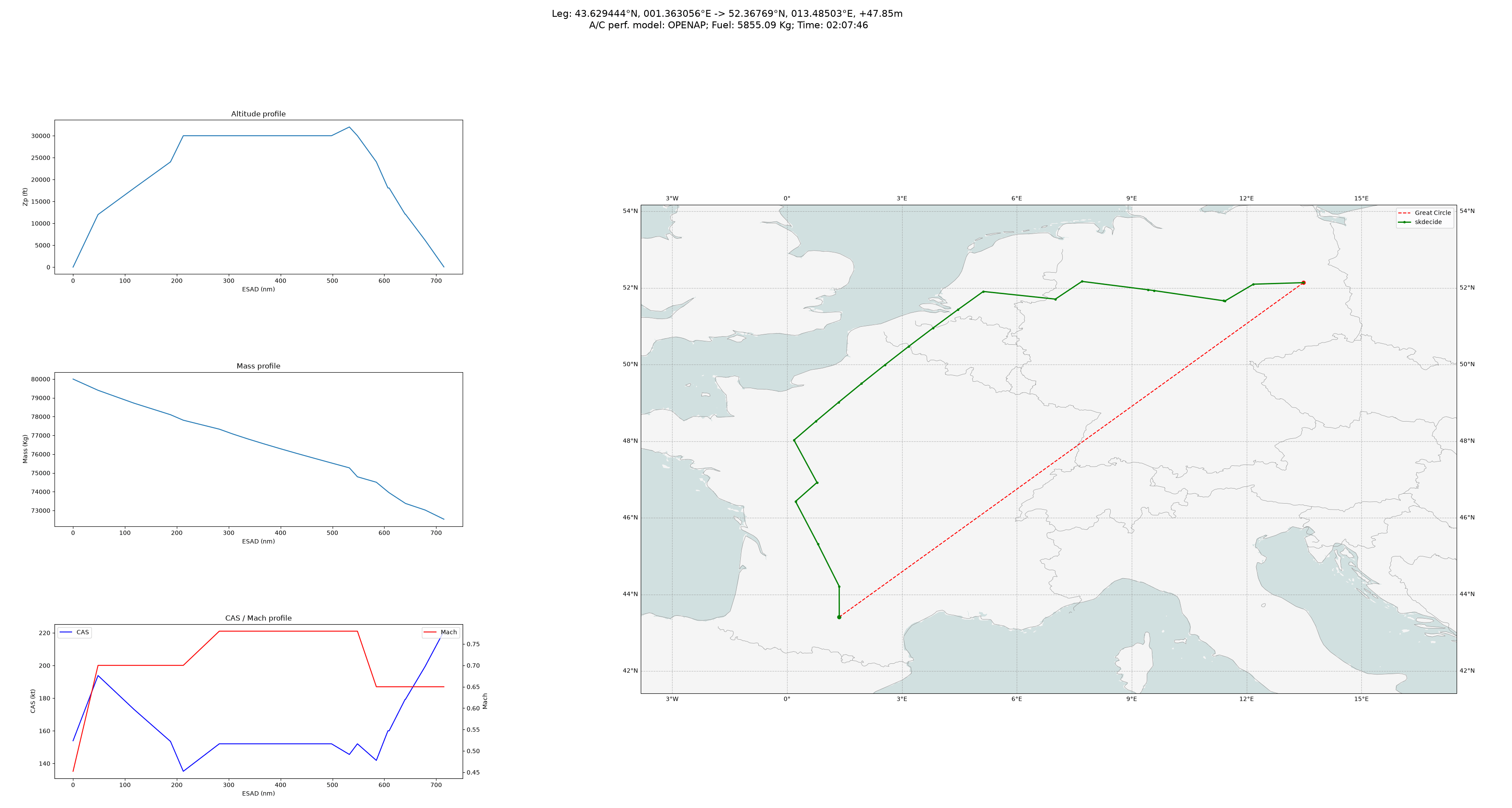
"Firms like Jeppesen have offerings in this space, but Scikit-decide, together with a narrow- and wide-body fuel consumption model built by a professor at the Delft University of Technology and wind data from NOAA, offer an open source solution."
So this is being positioned as an open source alternative to commercial offerings, which clearly it is not. If instead he made the limitations clear from the outset, that this is just a demonstration of what he/the tools are capable of and that this is not in any way intended for real-world use, it would put the rest of the article into better context.
I also don't see how Scikit-decide being developed by Airbus gives OP any domain authority. I use open source tools from all sorts of commercial ventures, and know nothing about how they themselves use them, or what for.
TacticalCoder 2 hours ago | parent
sccxy 5 hours ago | parent
t0mas88 3 hours ago | parent
And the output still has to be a valid flight plan route. You can't just file a flight plan for "I want this zig zag line at this altitude".
Commercial flight planning software does this optimization as well, but it only selects routes that are valid. For example you have to be at a certain altitude to go one way on a route and another altitude to go the other way. ATC can't do their job if you have planes pointing at each other in opposite directions doing 1000+ km/h.
codeduck 16 minutes ago | parent
Onavo 3 hours ago | parent
MiroslavPokorny 3 hours ago | parent
drpixie 1 hour ago | parent
That data looks to be rather arbitrary. Real aircraft performance is hugely dependent on aircraft weight, altitude, and ambient (air) temperature. And engine performance is very dependent on air temperature and airspeed. So your table of cruise/climb speeds etc might produce interesting results but the results are not going to be at all realistic.
To give you an idea of data complexity, all airliners come with hundreds or thousands of pages of closely printed tables giving performance at specified weight, temperature, altitude, etc.
fransje26 22 minutes ago | parent
> To give you an idea of data complexity, all airliners come with hundreds or thousands of pages of closely printed tables giving performance at specified weight, temperature, altitude, etc.
Make you wonder about who comes up with the theory on how to write those performance tables..
Scikit-decide, hosted by Airbus.